
How Agentic Delivery Works on Your Salesforce or Frontier AI Program: Inside OSF Digital’s Kepler
Schedule a meeting- Kepler starts in the systems your program already uses, with no new tools for your team.
- A team of specialist agents, each the digital twin of a delivery role, does the work between decisions. A named OSF Digital expert signs off every deliverable.
- Your workshops become findings the same day, and user stories in your backlog while discovery is still running, only after a person confirms.
- Your program’s data is isolated, and the system keeps improving from every program OSF Digital runs.
- Kepler is already running on live programs across multiple industries and the main Salesforce clouds.
What happens on day one of your program?
Kepler is set up inside the systems your program already lives in, such as Jira and Confluence, rather than adding new tools for your team. It’s deployed for your program alone, isolated customer by customer, and it runs on Anthropic’s Claude models under OSF Digital’s enterprise agreement.From that point, your program has one shared memory. Every decision, workshop, requirement, and lesson live in one place that every agent and every person on your program works from. More than 200 skills, written by OSF Digital’s best people, define how each task is done.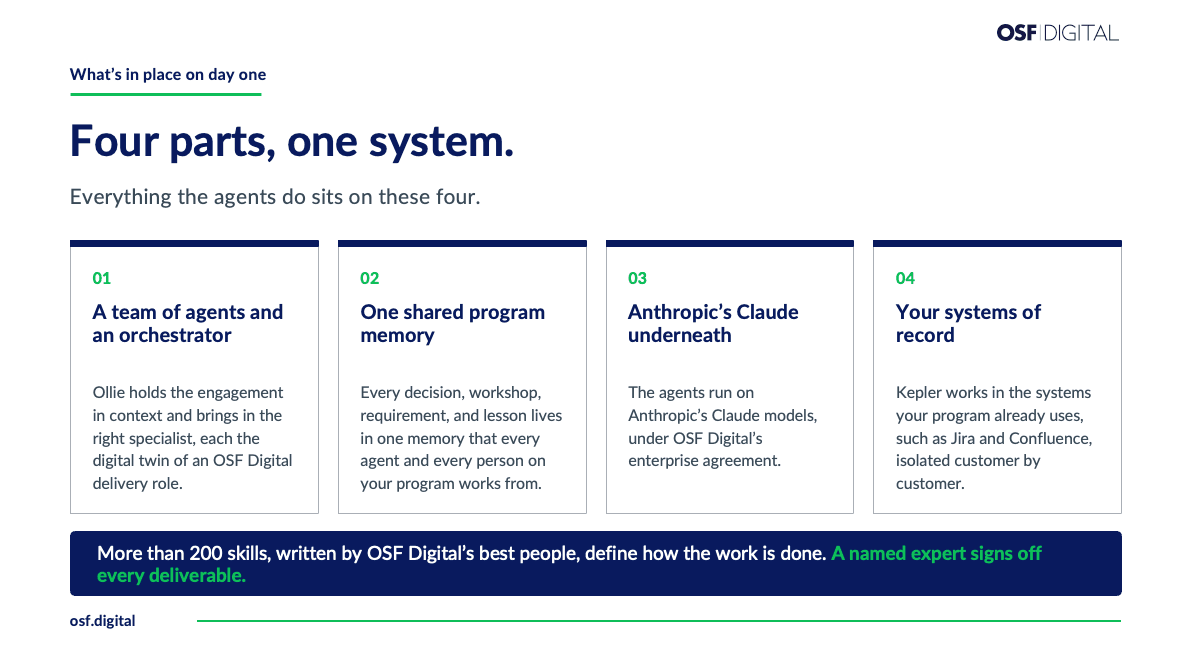
Who does the work on your program?
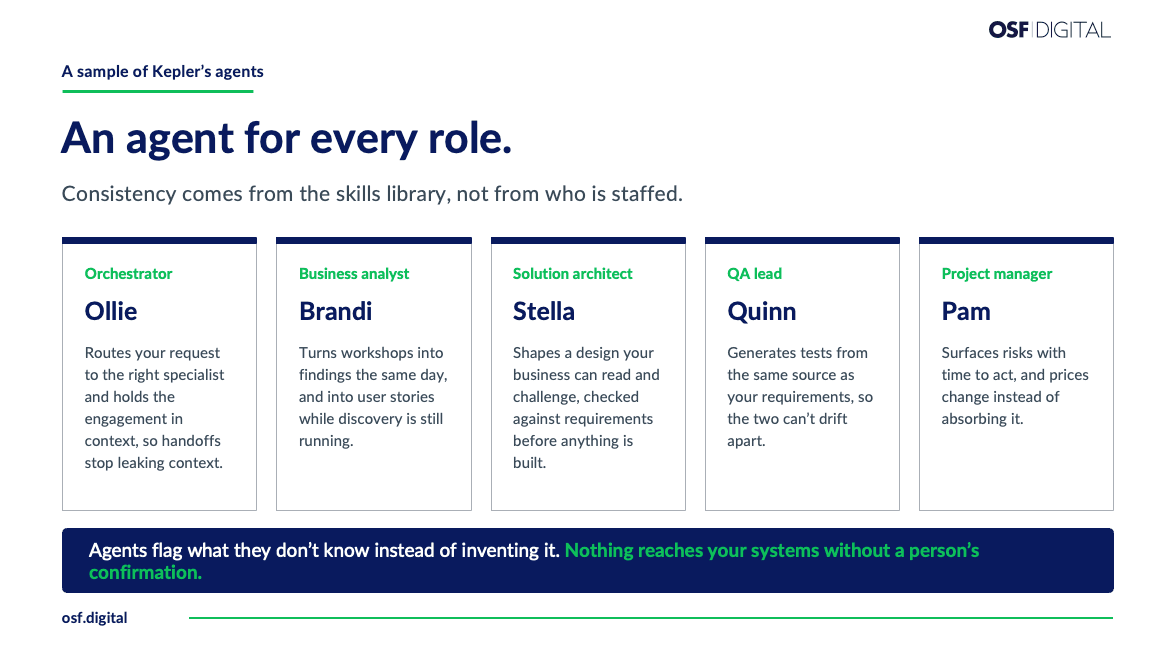
A team of specialist agents, led by an orchestrator, with OSF Digital’s senior experts behind each one. Each agent is the digital twin of a delivery role and carries a governed library of skills written by the people at OSF Digital who do that job best. So the standard on your program comes from the library, not from who happens to be staffed. A few examples:- Ollie, the orchestrator, routes each request to the right specialist and holds your whole engagement in context, so nothing leaks between handoffs.
- Brandi, business analyst, turns your workshops into findings the same day, and into user stories while discovery is still running.
- Stella, solution architect, shapes a design your business can read and challenge, checked against your requirements before anything is built.
- Quinn, QA lead, generates tests from the same source as your requirements, so the two can’t drift apart.
- Pam, project manager, keeps risk, scope, and change in view, so risks reach you with time to act, and change is priced, not absorbed.
How do your workshops become user stories?
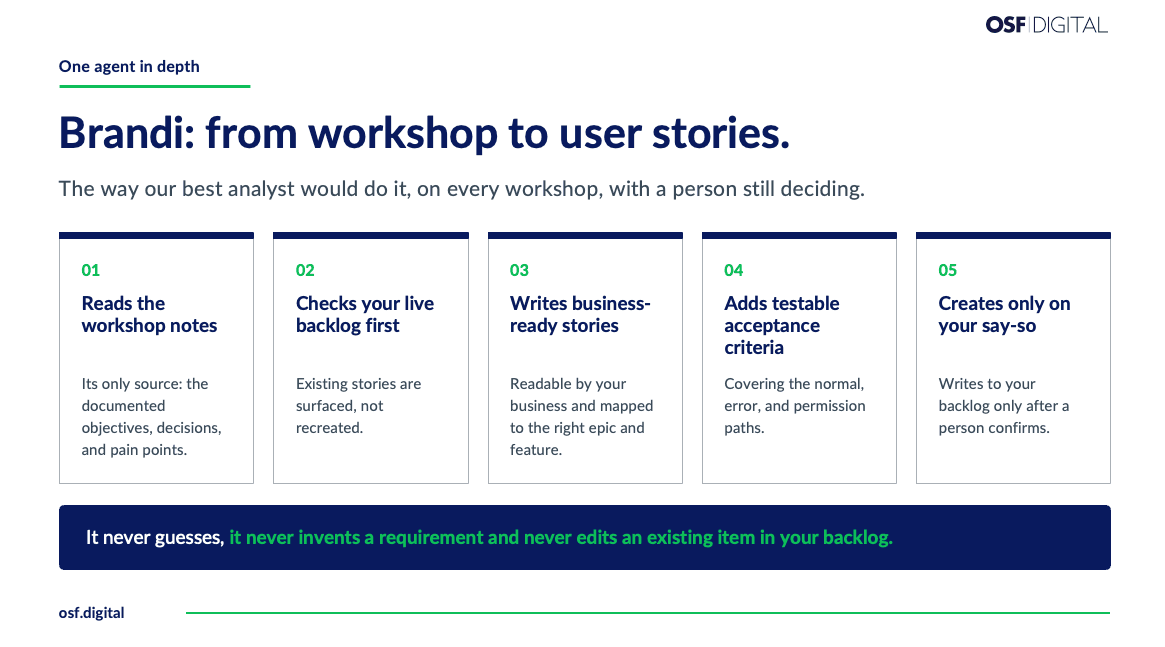
An illustrative example: after a day of discovery workshops with your team, the OSF Digital lead asks Ollie to turn the sessions into backlog items. Ollie brings in Brandi and briefs her with the workshop transcripts and your current backlog. Brandi then:- Reads the workshop notes. What your team said (objectives, decisions, pain points) is her only source.
- Checks your live backlog first, so existing stories are surfaced, not recreated.
- Writes business-ready stories, readable by your business and mapped to the right epic and feature.
- Adds testable acceptance criteria, covering the normal, error, and permission paths.
- Creates only on your say-so. Nothing is written to your backlog until a person confirms.
Who checks the work before it reaches you?
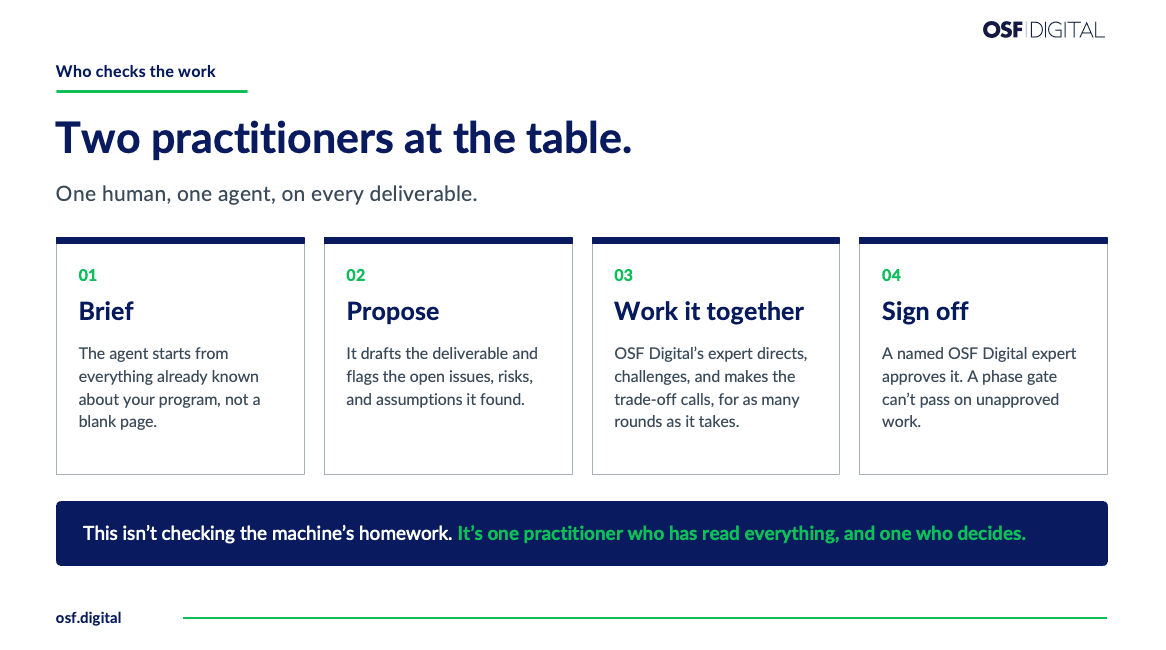
A named OSF Digital expert, on every deliverable. Each one is worked by two practitioners at the table, one human and one agent:- Brief. The agent starts from everything already known about your program, not a blank page.
- Propose. It drafts the deliverable and flags the open issues, risks, and assumptions it found.
- Work it together. OSF Digital’s expert directs, challenges, and makes the trade-off calls, for as many rounds as it takes.
- Sign off. The named expert approves it. A phase gate can’t pass on unapproved work, and Ollie, the orchestrator, never approves anything himself.
What happens to your data?
It stays yours. Your program runs on its own, with permissions, guardrails, and a full audit trail on by default. Your program’s context, decisions, and data are never shared with another customer, and Kepler runs under enterprise AI agreements, never consumer tools.Will the system keep up with your program, and with Salesforce?
Yes, because the people who run programs like yours are the people who improve it. An AI Council of senior OSF Digital practitioners owns the house standard and reviews every new or changed skill before release. AI Champions on live programs, in every region and practice, turn what works on real engagements into new and better skills.Every improvement follows the same loop (use, propose, govern, release), and your program inherits it automatically. Lessons learned on other programs reach yours without you paying for them to be rediscovered, kept current with a Salesforce platform that changes multiple times a year.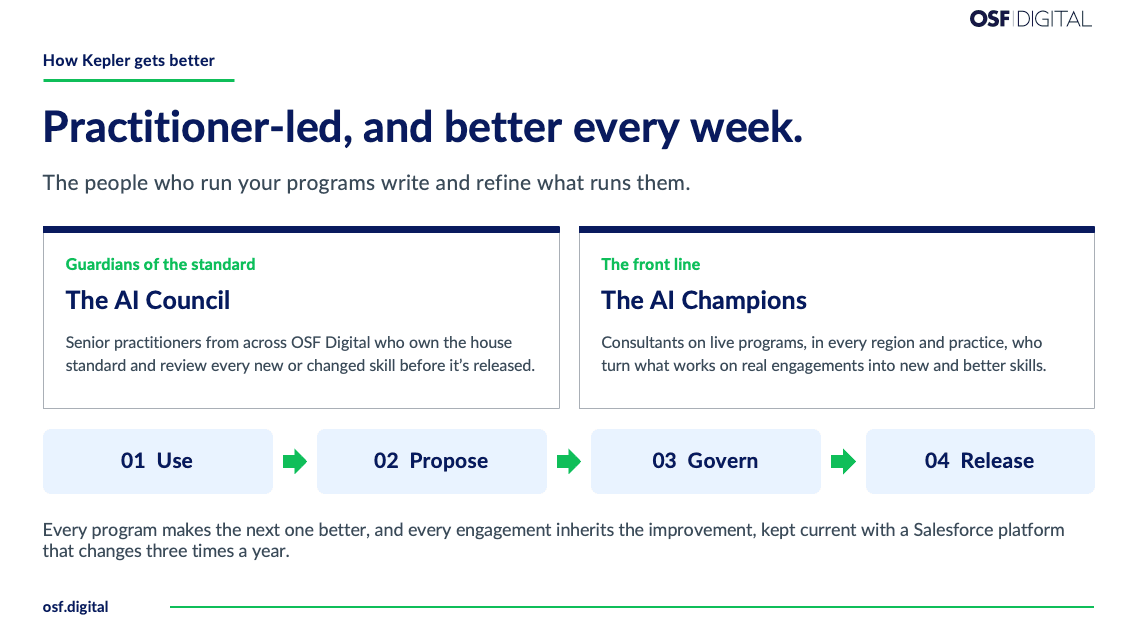
What results has Kepler delivered so far?
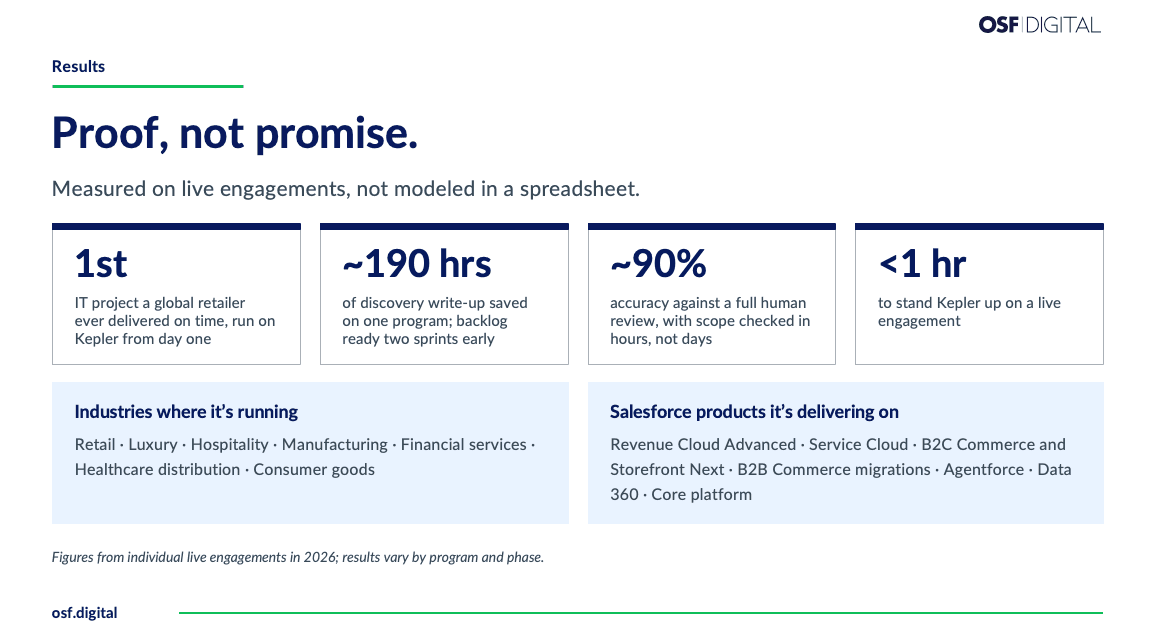
Kepler is already running on live Salesforce programs. Every figure here was measured on a real engagement, not modeled in a spreadsheet:- A first on-time IT project: a global retailer delivered its first IT project on time, with Kepler running from day one to outcome-based milestones.
- About 190 hours saved in discovery: recaps from 22 workshops drafted directly from transcripts, and the backlog ready two sprints early.
- Scope checked in hours, not days: every backlog item marked in or out of the statement of work with its source cited, at about 90% accuracy against a full human review.
- Under an hour to start: Kepler stood up on a live engagement in less than an hour.
- Share of the build, workstream by workstream: on one enterprise Service Cloud implementation, Kepler did 100% of the reporting build, about 90% of integration, and about 80% of the portal. It did about half of case management and agent-assisted service, about 25% of telephony, and about 18% of routing.
About OSF Digital
OSF Digital, an AI-forward, data-driven, Salesforce-centric consulting services company, helps global enterprises navigate technology complexity and modernize their operations through expert-led strategy, multi-cloud execution, and measurable outcomes.We combine deep technical expertise, industry insight, and a distinctive partnership mindset to simplify complexity and deliver real business value, from advisory through implementation to managed services. We work with Fortune 500 and regulated enterprises where the cost of getting it wrong is high, demonstrating measurable growth, building on trusted data, and putting intelligent agents into production.



FAQ
A digital twin is an AI agent modeled on a specific delivery role, such as a business analyst, solution architect, or QA lead. It works to the same standard on every program, and a named expert still directs its work and signs off what it produces.
Not with Kepler. It works in the systems of record your program already uses, such as Jira and Confluence, isolated customer by customer.
No. Agents propose and flag; people decide. Nothing is written to your backlog or systems without a person’s confirmation.
Kepler is running on live programs across Revenue Cloud Advanced, Service Cloud, B2C and B2B Commerce, Agentforce, Data 360, and Core platform, in retail, luxury, hospitality, manufacturing, financial services, healthcare distribution, and consumer goods.
OSF Digital’s AI Council, a group of senior practitioners who own the house standard and review every new or changed skill before it’s released to live programs.
 Agentic Delivery
 The New Era of Consulting: What Changes for Your Program When Delivery Goes Agentic
 Why Work With an AI-Native Partner on Your Salesforce or Frontier AI Program