

- Three changes landed at once: AI writes code quickly, capabilities are assembled rather than operated, and agents complete tasks in business systems.
- AIforce, formerly Headless 360, exposes Salesforce capabilities three ways: as APIs, as MCP tools, and as CLI commands.
- Permissions, workflows, validation, and governance travel with every call, and every hosted MCP transaction runs as the authenticated user.
- AIforce is not one uniform beta. Components carry different availability statuses.
- Find the logic that is duplicated across channels before rebuilding anything.
Why does this feel different from the last ten years?
Three forces landed at the same time, and the combination is what changed the shape of the work.Build is cheap and fast. AI writes and iterates code like a teammate, but faster.Capabilities are composable. Teams assemble services rather than operate applications.Agents do real work. They complete tasks in your systems rather than only answering questions.Any one of these on its own would be an incremental change. Together they change what a new channel costs to build, which changes how often someone will propose building one.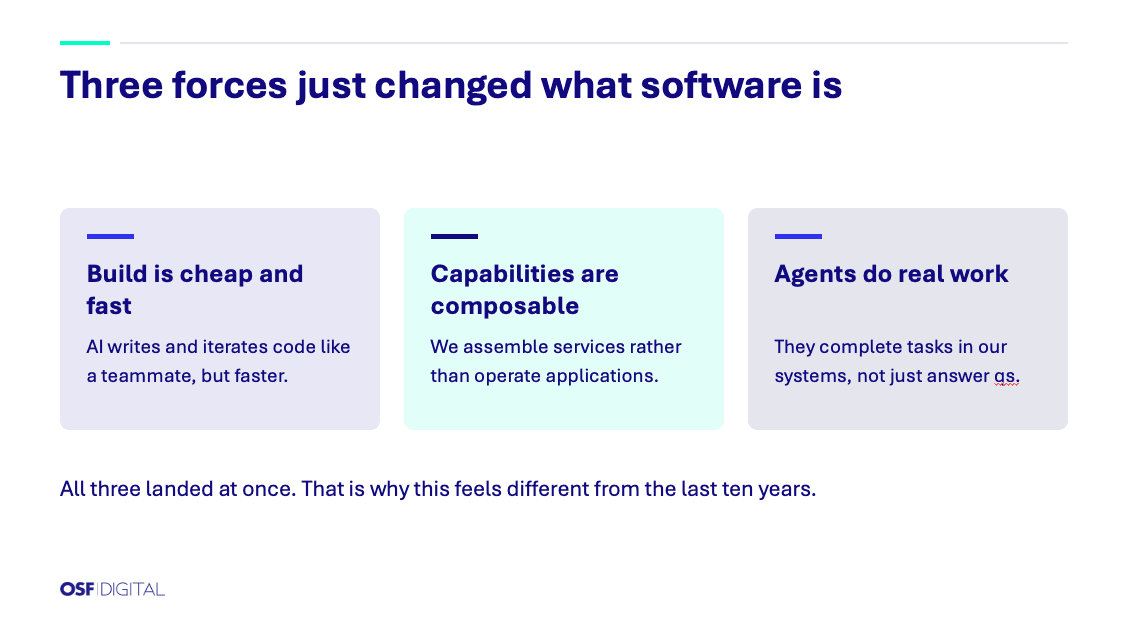
What is a surface, and why does it matter architecturally?
A surface is any place a user meets your business: a screen, a message, a voice call, a device, or an agent. The logic behind those surfaces does not change. Only the way people reach it changes.That distinction is the whole design question. If logic lives inside a surface, every new surface is a rebuild. If logic sits behind all of them, a new surface is a new client against an existing contract.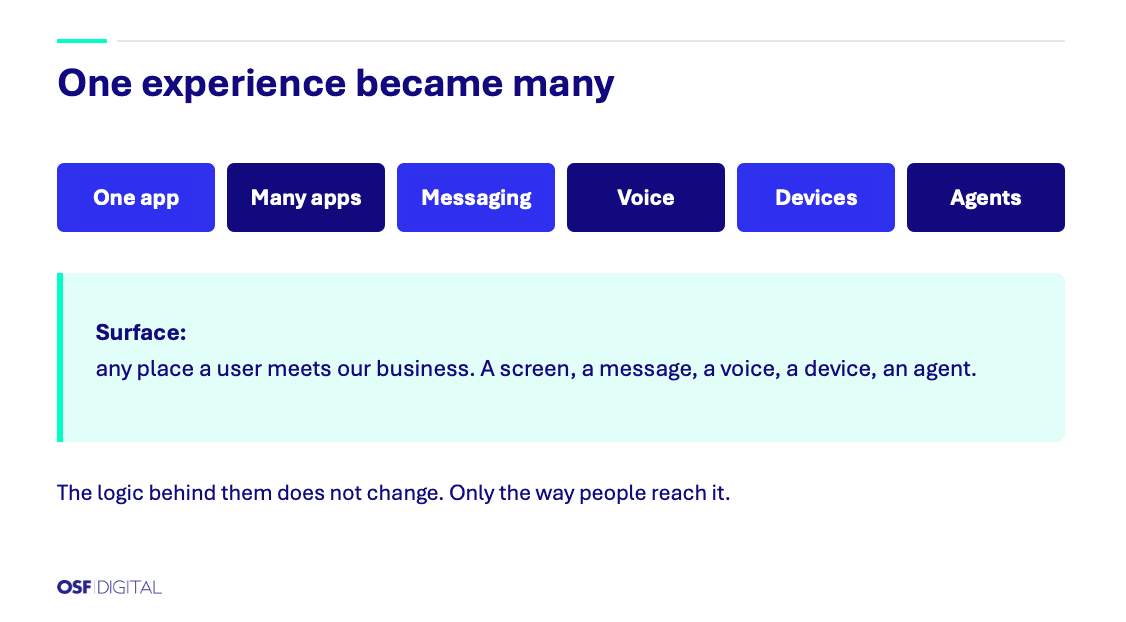
What did the single interface constrain?
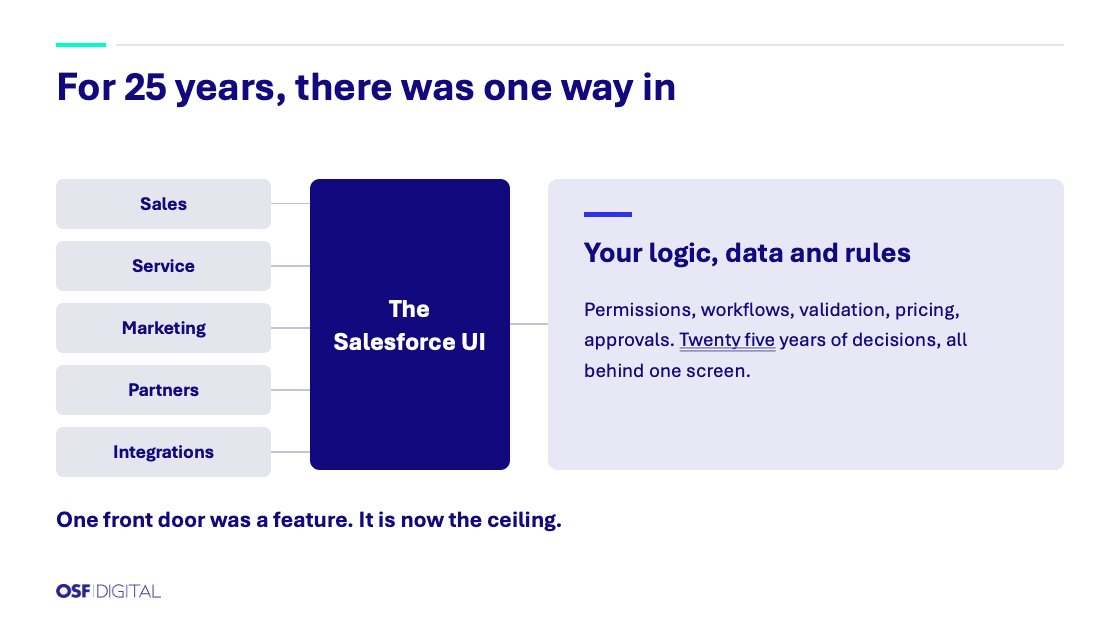
For 25 years, sales, service, marketing, partners, and integrations all reached your logic, data, and rules through the Salesforce interface. Permissions, workflows, validation, pricing, and approvals sat behind one screen, and that worked.The constraint is that the screen was the only way in. Any process that needed those rules somewhere else either went through an integration built for that purpose, or went without them."One front door was a feature. It is now the ceiling."
Rob Smith, SVP, OSF Digital
What does AIforce consolidate?
AIforce combines three moves that are often run as three separate projects: consolidate the logic once behind one governed core, let agents do more of the work inside business rules, and deliver it wherever people already are.Run as three projects, each one rebuilds part of what the others already have. Run as one, the logic is built once and the surfaces are clients.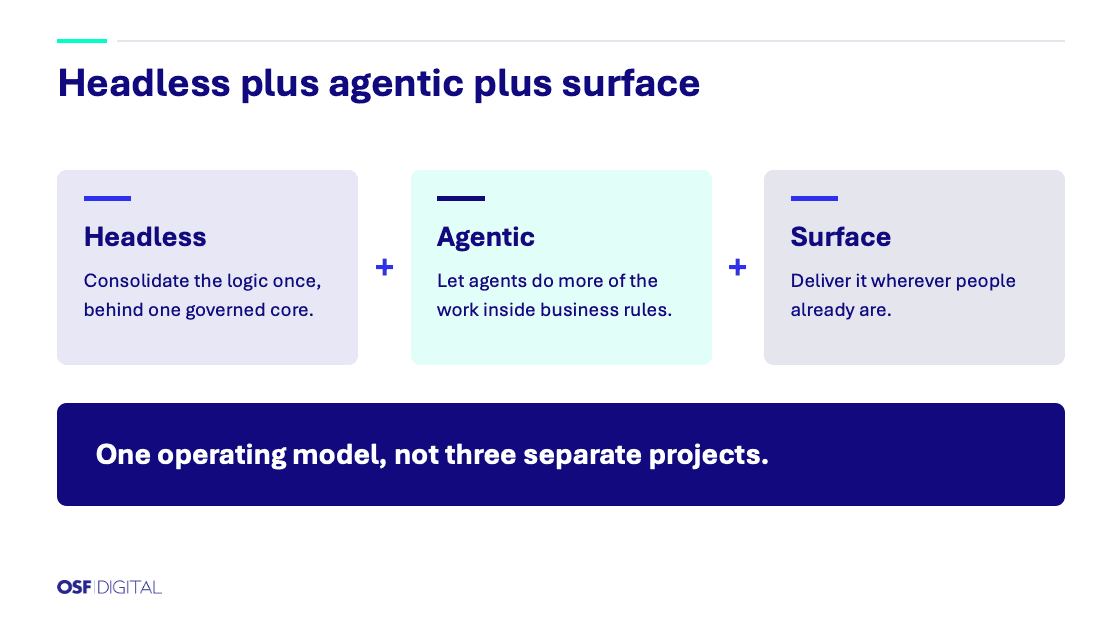
How do agents reach the core, and what travels with the call?
Any front door reaches one core through three access paths, and governance travels with every call. Permissions, workflows, validation, and sharing rules apply whether the request comes from the Salesforce interface, Slack, a voice channel, your own app, a device, or an agent running in Claude or ChatGPT.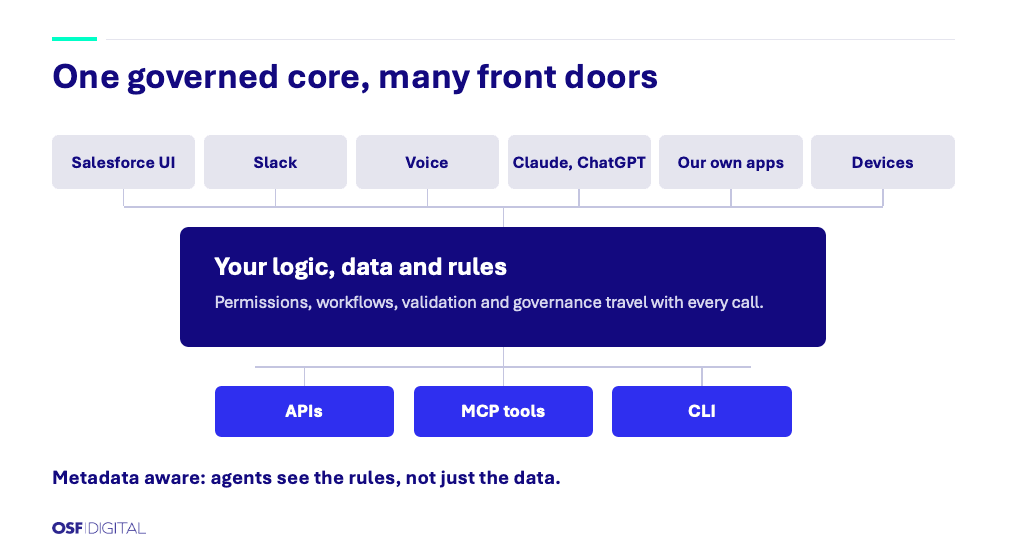
Why does your metadata decide what an agent can do?
Agents read your metadata to work out what your data means, so field names, descriptions, and picklist values become runtime inputs rather than documentation.A field named without a description has always been a maintenance problem. It is now also a source of wrong answers, because an agent has nothing else to interpret it with."Metadata aware: agents see the rules, not just the data."Before a first build, review the metadata for the objects that use case touches, rather than the whole org.
Rob Smith, SVP, OSF Digital
What does the Headless 360 MCP Server do?
The Headless 360 MCP Server gives an MCP-aware agent one connection to Salesforce through four tools rather than thousands. Those four tools belong to that server rather than to AIforce as a whole. Salesforce built it this way because exposing every feature as its own tool would make a model reason over thousands of tool descriptions before acting.Discover runs a semantic search across an index of every API and skill and returns ranked candidates.Describe pulls the technical contract for a skill, including parameters, dependencies, and ordered steps.Dispatch invokes the chosen skill, routing to the right endpoint and enforcing user access guards before anything runs.Dispatch Read Only runs read-only actions.What the beta contains today. Salesforce launched with roughly 100 skills, and at launch the majority are focused on Setup operations for admins, with cloud-specific skills arriving during the beta. If your first use case is a business process rather than an admin task, check that the operations you need exist.How identity works. Every hosted MCP transaction runs as the authenticated user, scoped through an External Client App. Object permissions, field-level security, sharing rules, profile permissions, and permission sets all apply, and the audit trail attributes every action to that user. Salesforce advises being deliberate about the permissions granted at the client level.Which parts are generally available, and which are in beta?
AIforce is not one uniform beta. Salesforce Multi-framework and the hosted MCP servers have been generally available since April 2026. The Headless 360 MCP Server has been in beta since July. The Experience Layer moved to open beta in August, when it was also renamed from Agentforce Experience Layer to Headless Experience Layer. Scope a first build around components that are generally available, unless you have a reason to accept beta terms, and check status again before contracting.What changes once the logic is consolidated?
Three things change. Agents act inside permissions with guardrails. Users get the same logic on Slack, voice, portals, or a phone, without a rebuild for each. And a rule changes in one place, after which every surface follows.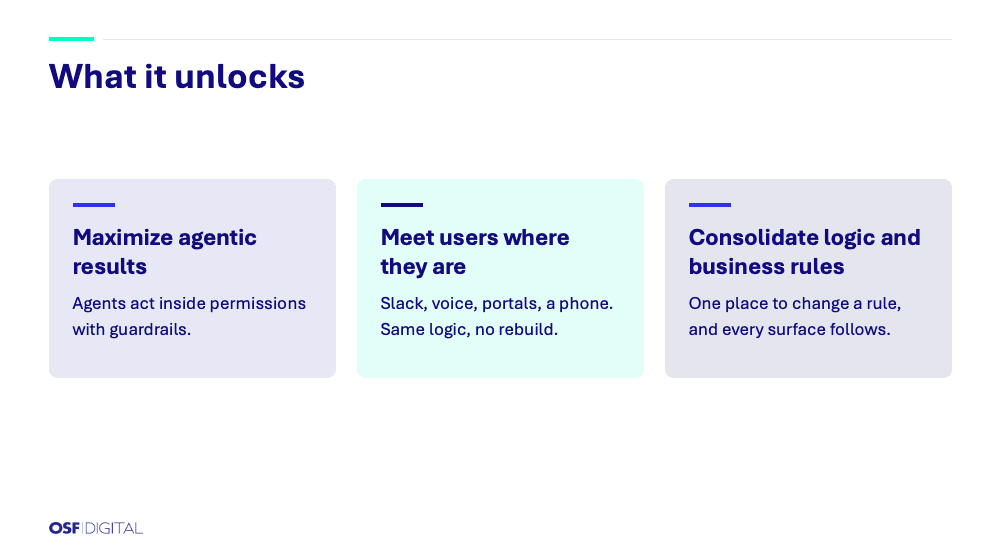
What should you design for?
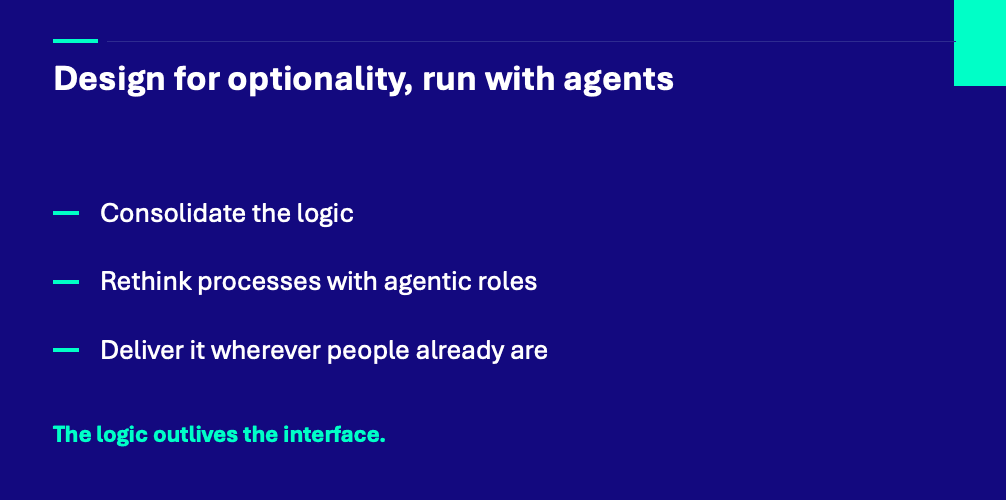
Design for optionality. Consolidate the logic, rethink processes with agentic roles, and deliver it wherever people already are. The clients will keep changing, and the logic is what stays."The logic outlives the interface."Rethinking processes with agentic roles is the part most often skipped. Deciding which steps an agent performs, which need a person, and what an agent may do without approval is design work, not configuration. Our piece for business leaders covers who makes those decisions.
Rob Smith, SVP, OSF Digital
Where should you start?
Start with the logic. Find what should be consolidated before anything gets rebuilt, which usually means the pricing rules, eligibility checks, approval thresholds, and routing logic that exist in several places at once.Then prove it in one journey, with one agent on one surface, in production. Then scale what works, adding surfaces without adding systems.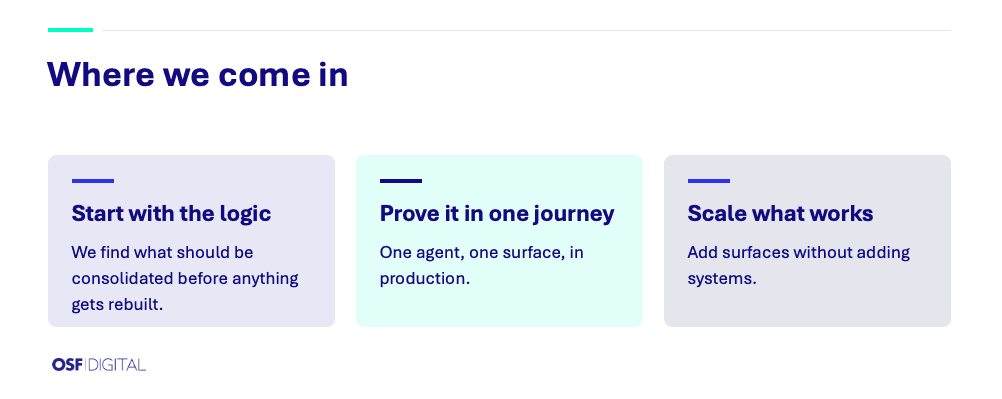
About OSF Digital
OSF Digital, an AI-forward, data-driven, Salesforce-centric consulting services company, helps global enterprises navigate technology complexity and modernize their operations through expert-led strategy, multi-cloud execution, and measurable outcomes.We combine deep technical expertise, industry insight, and a distinctive partnership mindset to simplify complexity and deliver real business value, from advisory through implementation to managed services. We work with Fortune 500 and regulated enterprises where the cost of getting it wrong is high, demonstrating measurable growth, building on trusted data, and putting intelligent agents into production.



Frequently asked questions
No. The Headless 360 MCP Server is one component within AIforce, formerly Headless 360. AIforce also includes other hosted MCP servers, the Agent Skills repository, the Headless Experience Layer, Salesforce Multi-framework, and coding tools. The components carry different availability statuses.
Every Salesforce hosted MCP transaction runs as the authenticated user, scoped through an External Client App. Object permissions, field-level security, sharing rules, profile permissions, and permission sets all apply, and the audit trail attributes each action to that user.
It launched in beta with roughly 100 skills, most focused on Setup operations for admins, with cloud-specific skills arriving during the beta. Confirm the operations your use case needs exist before scoping around it.
Testing an agent differs from testing deterministic code, because you are evaluating whether its reasoning produced an acceptable outcome across a range of inputs. Salesforce provides session tracing, custom scoring evals, and the Agentforce Testing Center for this.
Yes. Agents draw on the same allocation as your production integrations. Confirm current headroom and set explicit limits during scoping.