

The New Era of Consulting: What Changes for Your Program When Delivery Goes Agentic
Schedule a meetingWhat have you been living with on consulting programs?
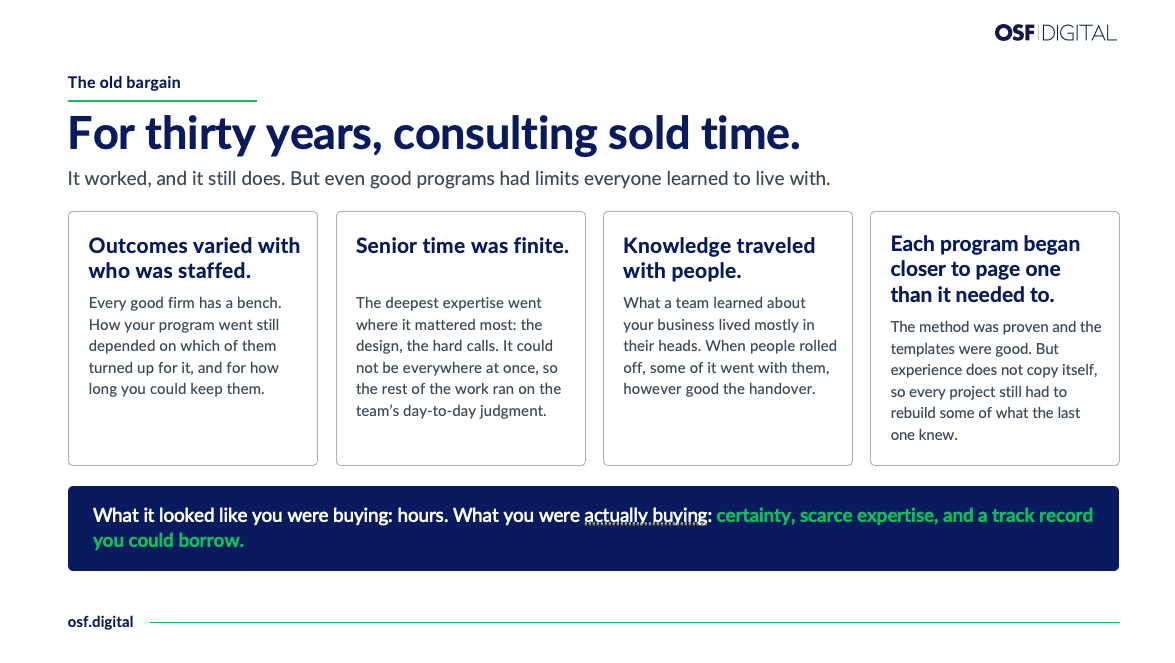
Even on a good program, with a good team, you’ve likely accepted limits that came with the model:- Your outcome depended on who was staffed. Every good firm has a bench. How your program went depended on which of them turned up for it, and for how long you could keep them.
- Senior expertise was rationed. The deepest expertise went to the design and the hard calls. It couldn’t be everywhere at once, so the rest of your program ran on the team’s day-to-day judgment.
- Knowledge about your business left with people. What a team learned lived mostly in their heads. When they rolled off, some of it went with them, however good the handover.
- Every program started closer to page one than it needed to. The method was proven, but experience doesn’t copy itself.
What should change for your program in the new era?
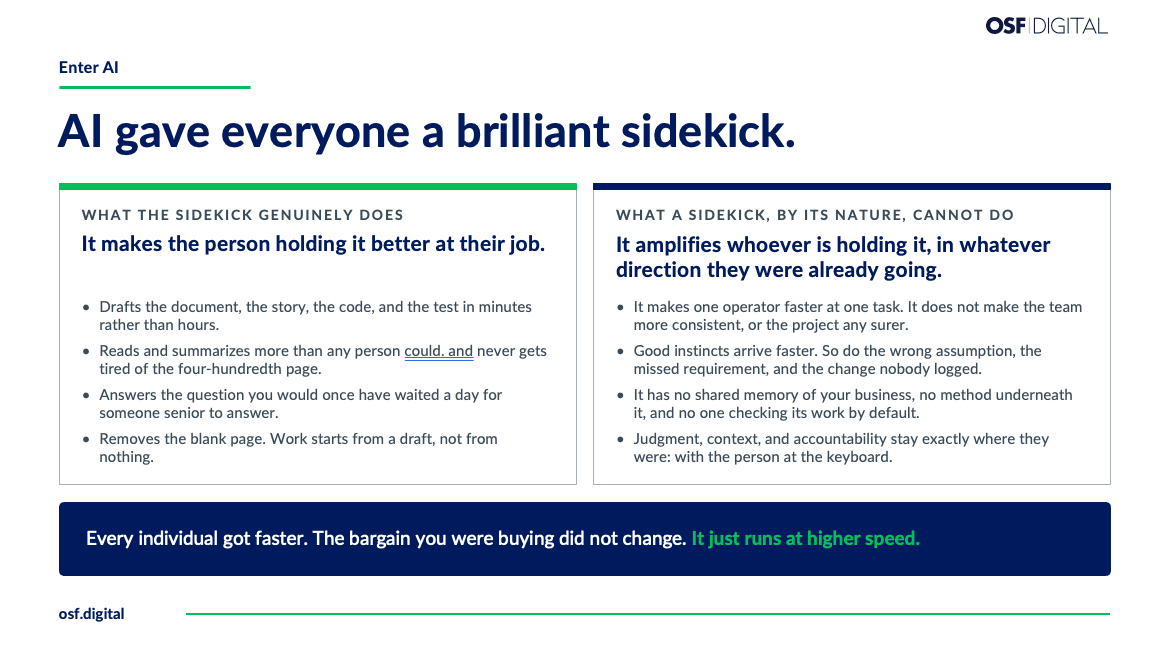
The new era of consulting changes what does the work, and who stands behind it. Delivery runs as a team, a memory, and a control tower, not a sidekick per person, with senior experts signing off every deliverable. For you, that shows up as three outcomes, together:- Speed: faster, without disrupting your business. The work between decisions (write-ups, documentation, mapping, test writing, status) is done in the flow of the program, so your team moves from decision to decision without the weeks in between, and your people spend their time deciding, not re-briefing.
- Quality: the best people’s judgment, on every task. The way the most experienced practitioners work reaches every task on your program, not only the ones they’re staffed on, and nothing depends on who was in the room.
- Cost: certainty, no expensive surprises. Your business intent is traced through design, build, and test. Scope drift and risk arrive in week three, as a conversation, not in week twenty, as a cost.
How can you tell if your partner is delivering in the new era?
Ask five questions:- Does the AI work from one shared memory of my program, or does knowledge still live with individual consultants?
- Is the partner’s method built into the AI, so quality holds whoever is staffed?
- Who signs off AI-produced work, and can a phase pass without that sign-off?
- Is my data isolated from other customers, with permissions and guardrails on by default?
- Can they show results from a live program, with the caveats attached?
How OSF Digital delivers in the new era: Kepler
Kepler is OSF Digital’s agentic delivery system and methodology for Salesforce and Frontier AI programs: OSF Digital’s best people, method, and everything learned, built into an operating system that runs the whole program. It isn’t a sidekick for each person. It’s a team, a memory, and a control tower. It’s deployed per customer, with one shared program memory, 12 specialist agents orchestrated by Ollie, the coordinator, and more than 200 skills that encode how OSF Digital’s best people work.Rob Smith, SVP OSF Digital, on the new era of consulting“Nothing goes to our customers, nothing gets built without human interaction and human judgment. Higher quality, higher speed, and lower cost. It’s the trifecta, and that’s what you should expect in the new era of consulting.”
— Rob Smith, SVP, OSF Digital
How Kepler delivers speed: a team, not a tool
- Compression of non-judgment work. Drafting, documentation, mapping, test writing, and status are done by the system, to OSF Digital’s standard.
- Your people stay focused on running the business. The write-ups, handovers, and re-briefing that used to need your time are carried by the system.
- An encoded method. OSF Digital’s method is no longer only in people’s heads and templates. It runs every task, the same way every time, from the first day.
How Kepler delivers quality: our seniors, made repeatable
- Senior depth, for everything. The way OSF Digital’s most experienced practitioners work is built into every task.
- One combined memory. Every decision, workshop, requirement, and lesson lives in one program memory that every agent and every person works from. Nothing depends on who was in the room.
- Shared lessons, pattern-matched to you. The patterns that worked, the estimates that held, and the lessons already learned are matched to your situation from the start.
How Kepler delivers cost certainty: a control tower, not just a worker
- Rework kept to a minimum. Your business intent is traced through design, build, and test, and contradictions surface before anything is built.
- Continuity through the life of the program. Decisions, context, and rationale live in your program’s systems of record, through every change of pace or personnel.
- Accountability you can see. A named OSF Digital expert signs off every deliverable, and a phase gate can’t pass on unchecked work.
- A global retailer’s first on-time IT project, with Kepler running from day one.
- About 190 hours of discovery write-up removed on one program, and the backlog ready two sprints early.
- Scope checked in hours, not days, at about 90% accuracy against a full human review.
About OSF Digital
OSF Digital, an AI-forward, data-driven, Salesforce-centric consulting services company, helps global enterprises navigate technology complexity and modernize their operations through expert-led strategy, multi-cloud execution, and measurable outcomes.We combine deep technical expertise, industry insight, and a distinctive partnership mindset to simplify complexity and deliver real business value, from advisory through implementation to managed services. We work with Fortune 500 and regulated enterprises where the cost of getting it wrong is high, demonstrating measurable growth, building on trusted data, and putting intelligent agents into production.



FAQ
AI is changing what consultants spend their time on. Drafting, documentation, analysis, and test writing that once filled billable hours can now be done in minutes. The bigger shift is structural: instead of each consultant using their own AI tool, leading partners run delivery as a system, with AI agents doing the work between decisions and experts making the calls.
No, but it changes what you should pay consultants for. AI handles much of the drafting, checking, and documentation, while trade-offs, design decisions, and accountability for the outcome still need experienced people. The consultants who matter most in the new era are the ones whose judgment is applied to every deliverable, not rationed across a program.
It’s under pressure. When AI compresses the work that filled consulting hours, hours stop being a good measure of value. What clients were really buying was certainty, scarce expertise, and a track record. Expect partners to shift the conversation toward outcomes: speed, quality, and cost improving together on your program.
An AI-native partner builds AI into how it delivers, not just into the tools its people use. In practice, that means AI agents working from one shared memory of your program, the partner’s method encoded into the work, and named experts reviewing and signing off every deliverable. OSF Digital delivers Salesforce and Frontier AI programs this way with Kepler.
The main risks are AI mistakes moving fast in the wrong direction, your data mixing with other clients’ data, and work no one has checked. Ask how the partner controls each one: who signs off AI-produced work, whether your program’s data is isolated, and whether AI runs under enterprise agreements rather than consumer tools.
It depends on the phase. The biggest gains are in work between decisions, such as discovery write-ups, user stories, documentation, and testing. On one OSF Digital program, agents removed about 190 hours of discovery write-up and the backlog was ready two sprints early. Design decisions and sign-offs still run at the speed of human judgment.
Judgment, trade-offs, and accountability. Agents draft, check, and flag what they find; experienced people direct the work, challenge the output, make the calls, and sign off every deliverable. In the new era, senior experts spend more of their time on judgment, not less.
Ask to see it on your own problem. A partner confident in its delivery should be able to show results from a live program, with the caveats attached, and work on a focused business problem before a full commitment. OSF Digital, for example, can show working use cases for a focused problem within 48 hours.