

Energy & Utilities Transformation: Lessons, Best Practices, and Returns from OSF Digital Programs
Schedule a meeting- Customer-data foundations repeatedly appeared before personalization, loyalty, self-service, and AI initiatives.
- Utilities generated faster returns by modernizing a specific customer or operational journey before expanding into broader programs.
- Self-service delivers operational value when customers can complete work rather than simply access information.
- Governance accelerated adoption when ownership, approvals, communications controls, and reporting standards were part of the initial scope.
- New revenue streams emerged when organizations reused existing foundations across additional products and services.
- AI appeared only after customer, stakeholder, communications, and workflow foundations were established.
What did OSF Digital's Energy & Utilities programs connect, and what did they deliver?
OSF Digital's Energy & Utilities programs connected customer engagement, commerce, onboarding, stakeholder communications, service operations, product expansion, marketing, and operational data. The outcomes ranged from customer-data unification and self-service adoption to communications modernization, new revenue enablement, governance improvements, and AI readiness.Global utility and energy company
The challenge: Customer data fragmented across multiple systems and identifiersWhat OSF Digital did: Implemented Data 360 and Marketing Cloud Engagement to unify profiles and engagementResults: Unified profiles, improved segmentation, personalized engagement, reduced inconsistencies, scalable customer-data foundationEnergy generation and trading provider
The challenge: Manual energy migration and evaluation processesWhat OSF Digital did: Built B2B Commerce ecosystem with simulator, onboarding, financing, and self-serviceResults: 15-week MVP, 5.0 CSAT, 50K visits, 700+ simulations, 510+ leads, 7x lead-generation increase, 1% conversion ratePremium oil and automotive products manufacturer
The challenge: Fragmented customer experience and disconnected dataWhat OSF Digital did: Created Data 360-centered strategy and Marketing Cloud Next roadmapResults: Personalization foundation, technology roadmap, loyalty strategy, executive alignmentIntegrated energy and utilities provider
The challenge: Manual contract and service-management activitiesWhat OSF Digital did: Built self-service portal integrated with SAP and Energy & Utilities CloudResults: Digital workflows, improved visibility, operational control, scalable self-service platformUtility and energy provider expanding services
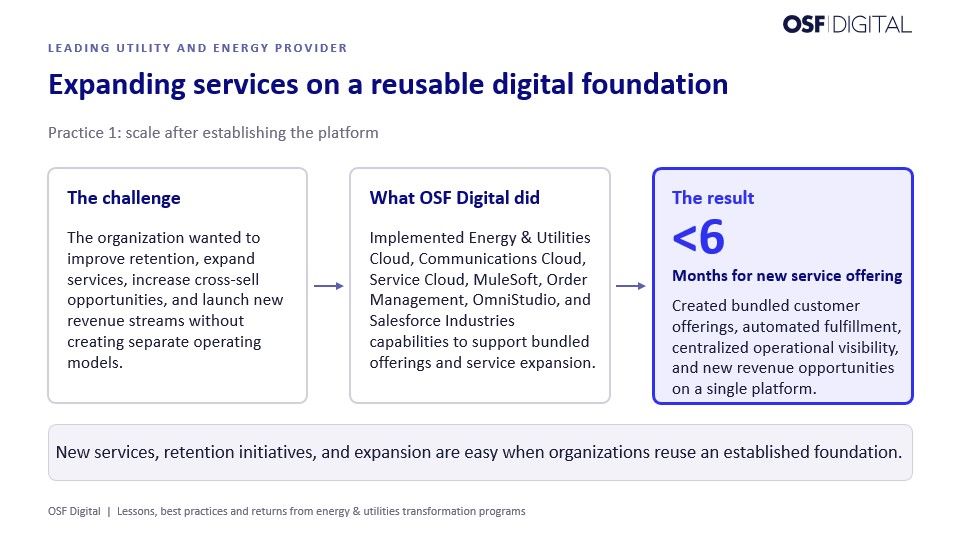
The challenge: Need to increase retention and launch new offeringsWhat OSF Digital did: Implemented Energy & Utilities Cloud, Communications Cloud, MuleSoft, and Order ManagementResults: New mobile service launched in under six months, bundled offerings, automated fulfillmentNational critical infrastructure operator
The challenge: Fragmented stakeholder communications and disconnected systemsWhat OSF Digital did: Implemented Sales, Service, Marketing, Shield, and Data 360 platformResults: 400-user deployment, communications moved from days to hours, AI-ready CRM, improved governance and complianceWhere did the biggest returns come from?
Energy & Utilities transformation programs produced the strongest returns when customer data, self-service capabilities, and operational workflows became part of daily execution rather than isolated technology projects.Unified customer data foundations enabled engagement, loyalty, and visibility
The challenge: Customer information was distributed across platforms, business units, data models, and identifiers. Marketing teams struggled with inefficient campaign execution and limited accessibility to customer data. A separate manufacturer program also identified fragmented customer views as a barrier to personalization, loyalty, and customer-centric operations.What OSF Digital did: OSF Digital implemented a customer engagement ecosystem powered by Data 360 and Marketing Cloud Engagement while also developing a broader customer-data transformation strategy centered on Data 360 and Marketing Cloud Next. The work included profile unification, audience segmentation, roadmap development, migration planning, training, and adoption support.The result: Organizations gained unified customer profiles, improved segmentation, scalable data architecture, reduced manual effort, fewer data inconsistencies, improved campaign execution, and a foundation for personalization and loyalty initiatives. Executive stakeholders gained a roadmap aligned to long-term business objectives and future growth.Why it matters: The same customer-data foundation supported onboarding journeys, service communications, billing interactions, marketing activation, personalization strategy, and future transformation initiatives. Rather than funding separate customer data projects for each business function, the organization created a single reusable foundation. Read the story →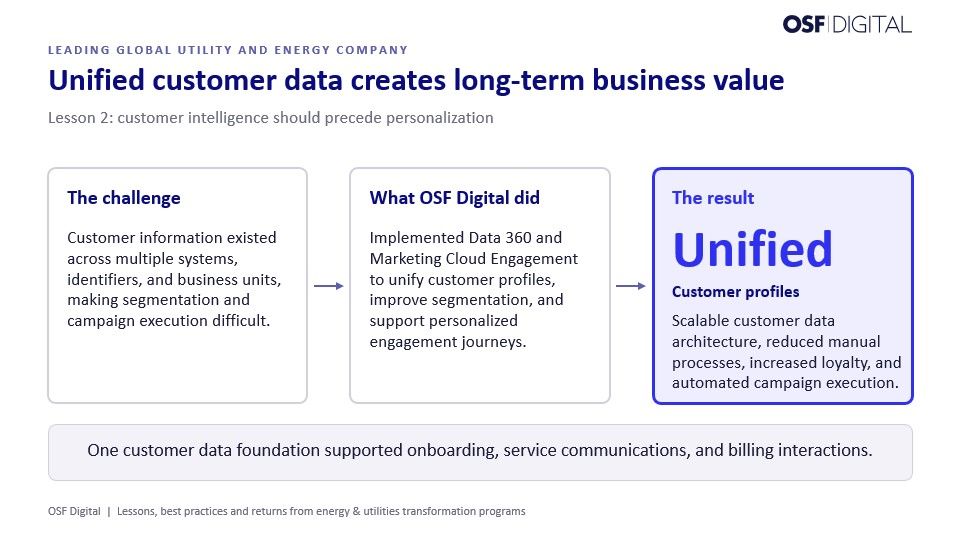
Self-service energy trading generated measurable customer adoption
The challenge: A leading energy generation and trading provider wanted to modernize its energy contract evaluation, onboarding, and migration processes. Existing processes relied heavily on manual effort and offered limited digital self-service capabilities.What OSF Digital did: OSF Digital built a digital energy-trading ecosystem using Salesforce B2B Commerce, Sales Cloud, Experience Cloud, and Marketing Cloud. The platform included an online energy-savings simulator, proposal automation, migration tracking, financing integration, and customer self-service.The result: The organization launched an MVP in just 15 weeks while achieving a reported 5.0 CSAT score. Within six months, the platform generated more than 50,000 website visits, supported more than 700 customer simulations, produced more than 510 leads, increased monthly lead-generation rates sevenfold, and achieved a reported 1% lead-conversion rate.Why it matters: Customer acquisition, onboarding, financing, migration, and self-service were managed through one connected experience. The same platform connected customer acquisition, onboarding, financing, migration tracking, and self-service into a single digital experience. Read the story →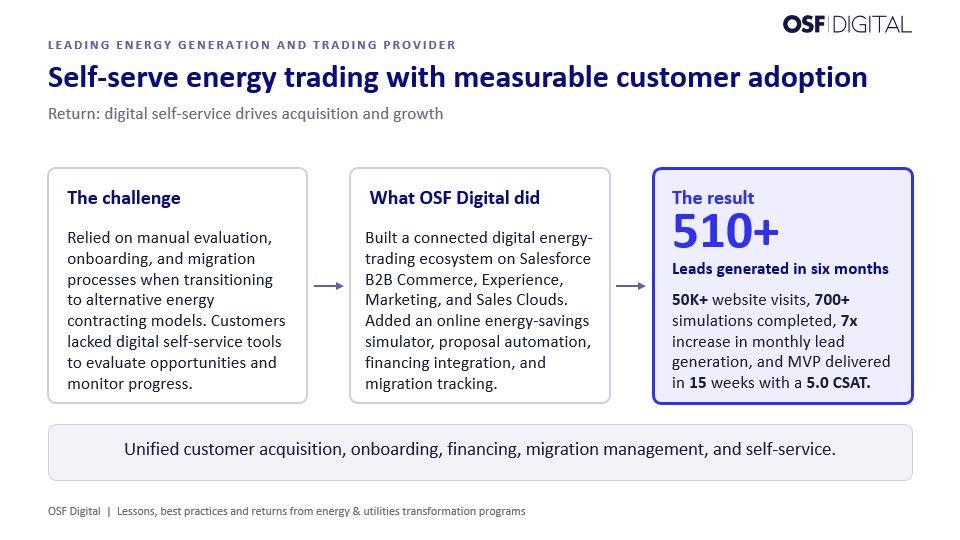
Self-service utility operations reduced manual work
The challenge: Business customers relied on representatives and manual processes for account activities, contract management, scheduling, and operational workflows. Existing self-service capabilities provided limited visibility and functionality.What OSF Digital did: OSF Digital implemented an end-to-end scheduling solution using Experience Cloud, Service Cloud, and Energy & Utilities Cloud. The platform integrated with SAP ERP, enabled Digital Engagement and WhatsApp communications, and digitized previously manual operational processes.The result: The organization launched the initial customer portal, digitized scheduling workflows, and supported adoption of self-service capabilities for account access, contract visibility, scheduling, and service management.Why it matters: The initiative focused on transactional self-service rather than informational self-service. Operational work moved into digital workflows where visibility, automation, and governance could scale over time.New service expansion created new revenue opportunities
The challenge: A utility provider wanted to improve retention, increase cross-sell opportunities, expand beyond a limited service portfolio, and create a unified customer experience across multiple offerings.What OSF Digital did: OSF Digital implemented Energy & Utilities Cloud, Communications Cloud, Service Cloud, MuleSoft, and Order Management. The platform used OmniStudio and Industry Cloud components to support a new mobile plan offering and to create a single operational foundation across services.The result: The organization launched a new service offering in less than six months, automated order orchestration and fulfillment, established a single source of truth for customer and operational data, and enabled bundled offerings spanning gas, electricity, broadband, and mobile services.Why it matters: New offerings did not require a separate platform. The organization reused a single operational foundation across multiple products and services, enabling bundled offerings, automated fulfillment, and consistent customer experiences.What do OSF's Energy & Utilities programs show?
Energy & Utilities transformation programs reveal five recurring business-value patterns: focused journeys accelerate results, customer data enables scale, operational modernization matters more than interfaces, governance supports growth, and AI follows maturity.Lesson 1: Customer and operational journeys create value faster than enterprise-wide transformation
The pattern: Programs consistently started with a specific journey such as customer onboarding, account management, energy migration, stakeholder communications, scheduling, or self-service operations.The lesson: Transformation initiatives gain momentum when teams can connect delivery to a measurable operational problem rather than an abstract enterprise objective. Early wins create evidence, sponsorship, and adoption.What OSF Digital deployed: Onboarding journeys, migration workflows, simulators, self-service portals, communications platforms, and scheduling solutions.Lesson 2: The programs show how reusable foundations can support future expansion
The pattern: Data 360 appeared across multiple initiatives. Strategic roadmaps and customer data foundations enabled subsequent investments in personalization, loyalty, engagement, and service expansion.The lesson: The first phase should be evaluated by what it enables next, not only by what it delivers immediately. Reusable foundations reduce redesign effort during future phases.What OSF Digital deployed: Customer-data foundations, roadmap planning, segmentation frameworks, Marketing Cloud migrations, and centralized operating models. Read the story →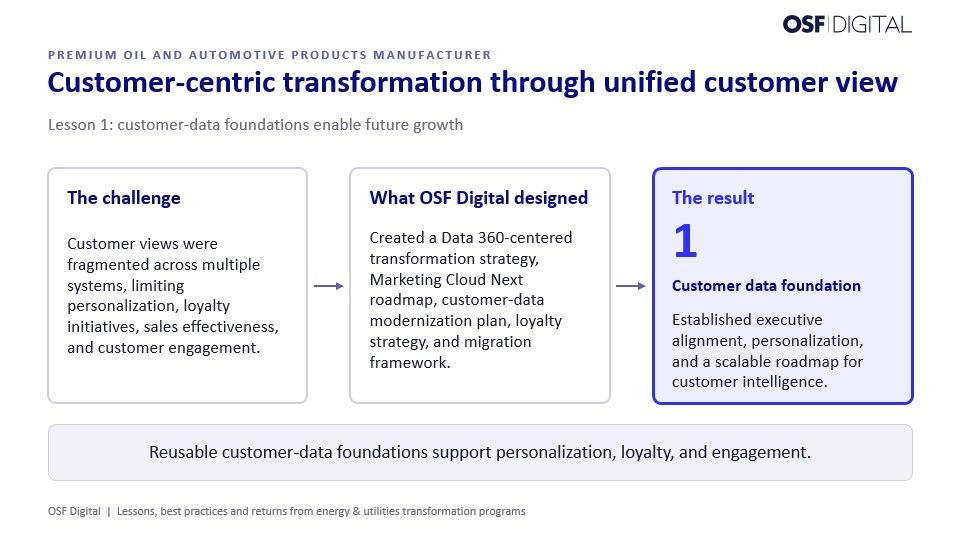
Lesson 3: Operational modernization brings more benefits than interface modernization
The pattern: Successful programs automated proposal generation, migration tracking, scheduling, order orchestration, communications management, and customer operations.The lesson: Operational efficiency comes from removing manual work and creating workflow visibility, not simply introducing new screens.What OSF Digital deployed: Digital workflows, self-service operations, onboarding automation, stakeholder engagement models, and operational control mechanisms.Lesson 4: Governance can support broader adoption and expansion
The pattern: Roadmaps, approval models, communications controls, auditable processes, escalation structures, and change-management activities were implemented alongside delivery work.The lesson: Governance supports growth when ownership, measurements, and controls are established early. Programs scale more effectively when governance is built into the operating model rather than added later.What OSF Digital deployed: Approval workflows, communication governance, stakeholder frameworks, business-case development, and auditable operating procedures. Read the story →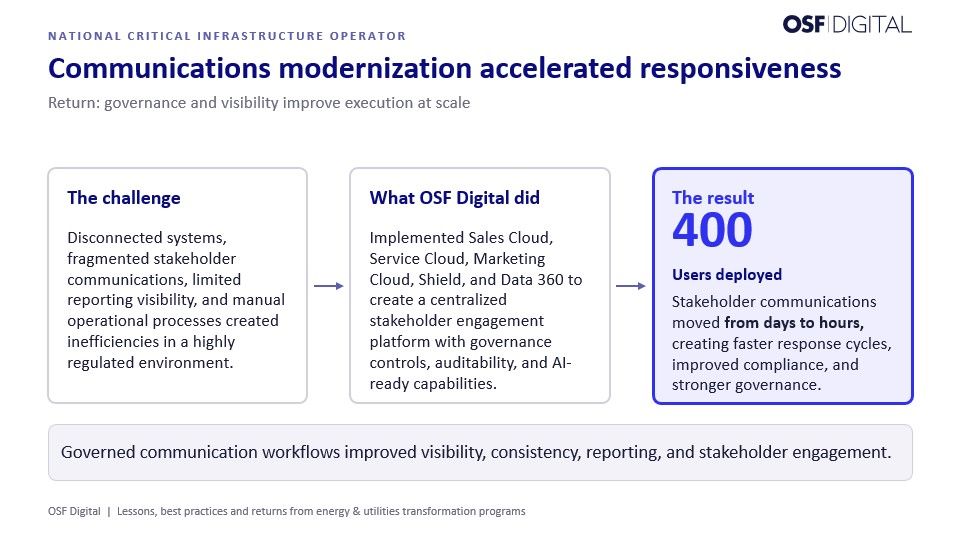
Lesson 5: Introducing AI after establishing operational maturity
The pattern: Agentforce appeared only after organizations had established customer data visibility, communications governance, stakeholder management, and operational control.The lesson: AI readiness depends on trusted data, governed workflows, and operational ownership more than on technology availability.What OSF Digital deployed: Data 360, communications foundations, governance controls, and Agentforce pilot capabilities.Which best practices does OSF apply in Energy & Utilities transformations?
Energy & Utilities transformations create more value when they sequence modernization efforts deliberately rather than attempting to solve every challenge simultaneously.Practice 1: Start with a customer or operational journeyChoose onboarding, scheduling, migration, self-service, communications, or account management as a measurable starting point. Practice 2: Build customer-data foundations earlyCustomer identity, segmentation, and visibility repeatedly appear before meaningful gains in personalization, engagement, and loyalty.Practice 3: Make self-service transactionalCustomers should be able to complete work, not simply view information. The strongest programs supported scheduling, onboarding, contracts, service management, and migration activities. Read the story →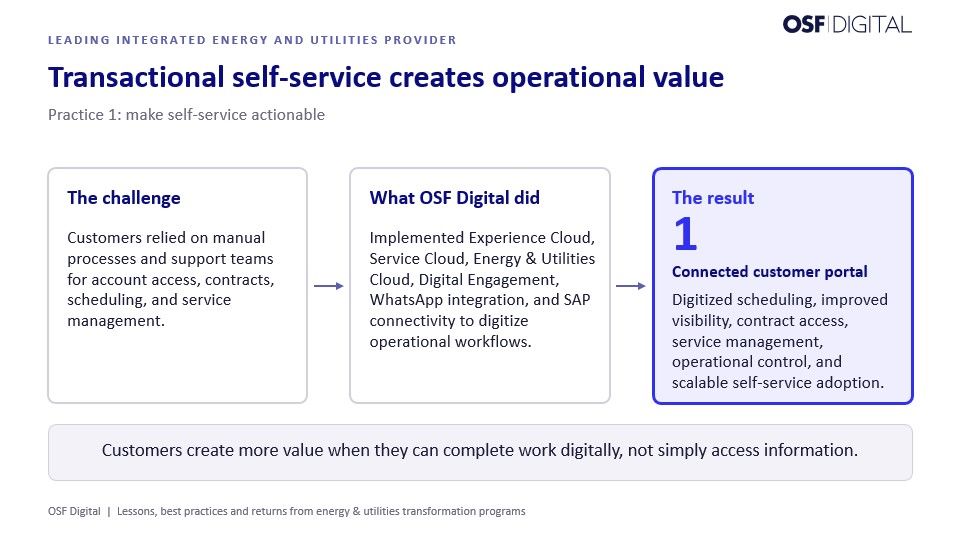
How can Energy & Utilities leadership teams apply these lessons to their own operations?
Energy & Utilities leadership teams can apply these lessons by prioritizing operational friction, data readiness, measurable outcomes, and future reusability.Value and frictionStrong first-phase candidates include:- Customer onboarding
- Contract migration
- Self-service account management
- Scheduling workflows
- Stakeholder communications
- Service delivery coordination
- Current operational friction
- Data quality and visibility
- Manual effort that can be removed
- Potential adoption measures
- Reuse across future programs
Final Thoughts
Energy & Utilities leaders should prioritize operational health. Organizations often discover that fragmented data, manual workflows, disconnected communications, and inconsistent visibility create greater barriers than technology itself. The programs reviewed here show that customer-data unification, transactional self-service, governance, and operational modernization reinforce one another when deployed as part of a connected operating model.The strongest transformations began with a specific journey, established reusable foundations, measured adoption, and then expanded to include additional capabilities. That pattern appears consistently across customer engagement, self-service operations, new service launches, stakeholder communications, and AI readiness initiatives.


Frequently Asked Questions
No. Multiple programs integrated existing platforms, SAP environments, communication tools, and operational systems while building modern customer-facing and stakeholder-facing experiences.
The strongest candidates are cross-functional journeys with measurable operational friction, such as onboarding, contract migration, scheduling, self-service, customer communications, and stakeholder engagement.
Customer data visibility supports personalization, engagement, reporting, operational efficiency, and communication. Several reviewed programs established Data 360 foundations before pursuing broader transformation goals.
Self-service becomes valuable when customers can complete transactions, manage services, monitor progress, and access operational information without relying exclusively on support teams.
The reviewed programs suggest introducing AI only after the customer data, communications, governance, and workflow foundations are already functioning effectively.
Organizations should measure adoption, workflow execution, communication speed, operational visibility, lead generation, service efficiency, and business outcomes separately rather than relying on deployment metrics alone.
 Why Work With an AI-Native Partner on Your Program
 2026 Digital Transformation Strategy & Innovation Playbook
 AI-First Service: Turn Every Interaction into Lifetime Value