

Automotive Sales and Aftersales Integration: Lessons, Practices, and Returns from OSF Digital Programs
Schedule a meeting- Automotive sales and aftersales integration pays off when the same customer, dealer, vehicle, inventory, order, and service context supports multiple functions rather than a single interface.
- A multi-cloud program connected dealer and customer journeys across two markets and reported a 6% conversion increase, 163,000 additional retained customers, R$29.9 million in added operational profit, and R$2.3 million ROI within 12 months.
- A global dealership program reduced fragmentation by consolidating two mature CRM environments into one Salesforce Sales and Service foundation while retaining justified regional requirements.
- Dealer self-service produces operational value when activity updates the same records and workflows used by sales, service, parts, and support teams.
- AI belongs in a named sales or service task after data, permissions, knowledge, exception handling, and measurement have been defined.
- The first market or dealer group should be judged by the reusable operating template it creates, not only by whether the technology goes live.
What did OSF Digital's automotive programs connect, and what did they deliver?
OSF Digital’s automotive programs connected customer, dealer, sales, service, marketing, commerce, field execution, and operational data, resulting in outcomes ranging from a reusable global CRM foundation to measured gains in conversion, retention, adoption, and profit.Global dealership organization
The challenge: Two mature CRM environments, regional process differences, and large volumes of customer, dealer, sales, service, and operational data.What OSF Digital did: Consolidated Sales Cloud and Service Cloud; connected supporting systems with MuleSoft; added Marketing Cloud and Experience Cloud self-service; standardized governance and workflows.The result: One global operating foundation adopted across Sales, Service, Finance, IT, and Operations, with dealer and customer access to shared information.Automotive aftermarket manufacturer and distributor
The challenge: A legacy sales platform needed to support a distribution network serving more than 60,000 retail locations, including mobile and offline field work.What OSF Digital did: Implemented Consumer Goods Cloud Retail Execution, integrated ERP through MuleSoft, enabled mobile and offline execution, and introduced Agentforce guidance.The result: Field sales and distribution teams adopted visit planning, account management, order capture, task prioritization, and AI-assisted recommendations.Dealership and mobility group
The challenge: Customer data and processes were split across vehicle sales, service, parts, financing, fleet, support, and commerce.What OSF Digital did: Designed a Salesforce ecosystem spanning Sales, Service, Marketing, Automotive Cloud, Financial Services Cloud, Data 360, B2B and B2C Commerce, MuleSoft, and Agentforce.The result: More than 55 business processes redesigned and 1,500+ user stories defined; architecture used more than 80% standard Salesforce functionality.Automotive distributor and dealer network
The challenge: Sales representatives needed faster access to product, competitive, and financing knowledge inside opportunity work.What OSF Digital did: Implemented six AI-powered sales coaching agents with Agentforce and Sales Cloud, grounded in CRM data, knowledge articles, and business documentation.The result: Sales and account teams adopted real-time guidance, next-best actions, product recommendations, competitive context, and financing support in the sales workflow.Automotive manufacturer
The challenge: Country business units needed a repeatable regional model for CRM, dealer commerce, service, marketing, customer data, and preferred-channel communication.What OSF Digital did: Connected Sales, Service, Experience, Marketing, B2B Commerce, Automotive Cloud, and MuleSoft, with WhatsApp integration and a reusable country framework.The result: Across two markets: 6% higher conversion, 163,000 additional retained customers, R$29.9M added operational profit, R$2.3M ROI within 12 months, 10,000 campaigns in five months, 4,000+ users on the new communication process, a reported 462% increase in page views, and a reported 53% increase in access representativity within one year.Multinational industrial and mobility organization
The challenge: Fragmented systems and manual ordering for subscription-based technical content limited subscription management, order visibility, renewals, and customer self-service.What OSF Digital did: Implemented Agentforce Revenue Management and B2B Commerce with MuleSoft integration to connect Salesforce and SAP; migrated 40,000 SKUs; added automated quoting, pricing, ordering, renewals, account controls, and order tracking.The result: A unified B2B commerce experience replaced disconnected purchasing workflows and gave multiple customer stakeholders self-service access to order history, subscription status, and account information.Where did the biggest conversion and operational profit come from?
Automotive integration programs generated the strongest measurable returns by reusing connected customer and dealer data across marketing, sales, service, commerce, and communication workflows.One regional ecosystem: 6% higher conversion, 462% more page views, and 163,000 additional retained customers
The challenge: Country business units used distinct dealer networks and engagement models, while customer, dealer, sales, service, and marketing information needed to move across the lifecycle.What OSF Digital did: Sales Cloud, Service Cloud, Experience Cloud, Marketing Cloud, B2B Commerce, Automotive Cloud, MuleSoft, and WhatsApp integration created a connected operating pattern. The pattern was implemented across two South American markets and adapted to local priorities.The result: Connected journeys and automated campaigns supported a 6% conversion increase, 300 converted leads in the first five months, 163,000 additional retained customers, R$29.9 million in additional operational profit, and R$2.3 million ROI within 12 months. The same program launched 10,000 campaigns in five months and moved more than 4,000 users to a new customer communication process.Why it paid back: The investment did not stop at CRM consolidation. The same integration and governance pattern supported dealer collaboration, campaign execution, lead management, service context, commerce, and preferred-channel communication. Read the story →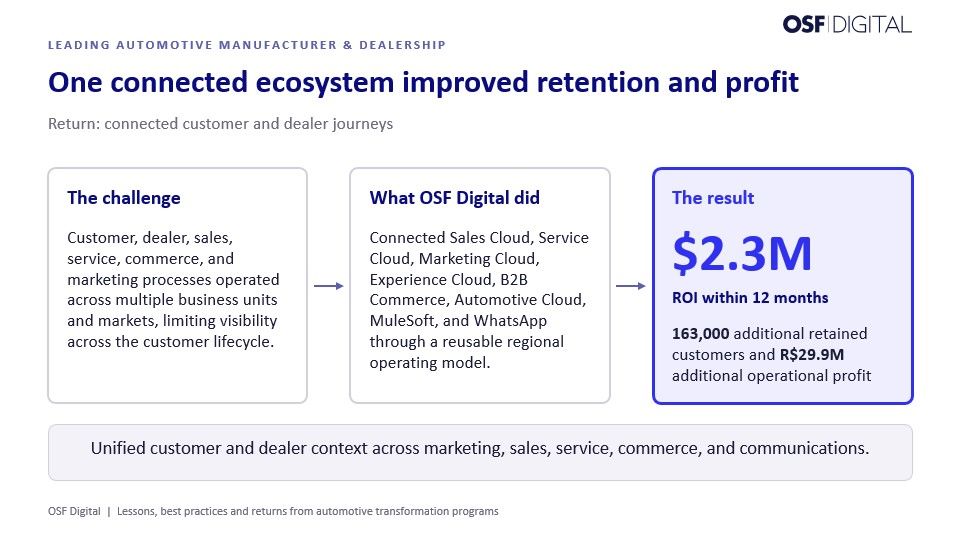
Two CRM environments consolidated into one global foundation
The challenge: a global dealership organization needed to consolidate two mature CRM environments without interrupting operations or removing justified regional differences. What OSF Digital did: a unified Salesforce Sales and Service platform combined customer and dealer records, integrations, Experience Cloud self-service, automation, migration, governance, and change support.The result: Sales, Service, Finance, IT, and Operations adopted common processes and shared data, while dealer and customer portals expanded access to information. The evidence provided supports operating-model reuse and continuity, but the source does not provide externally validated financial or conversion metrics.Why it matters: a shared foundation makes later expansion, acquisition integration, and local rollout less dependent on rebuilding the same definitions and controls. Read the story →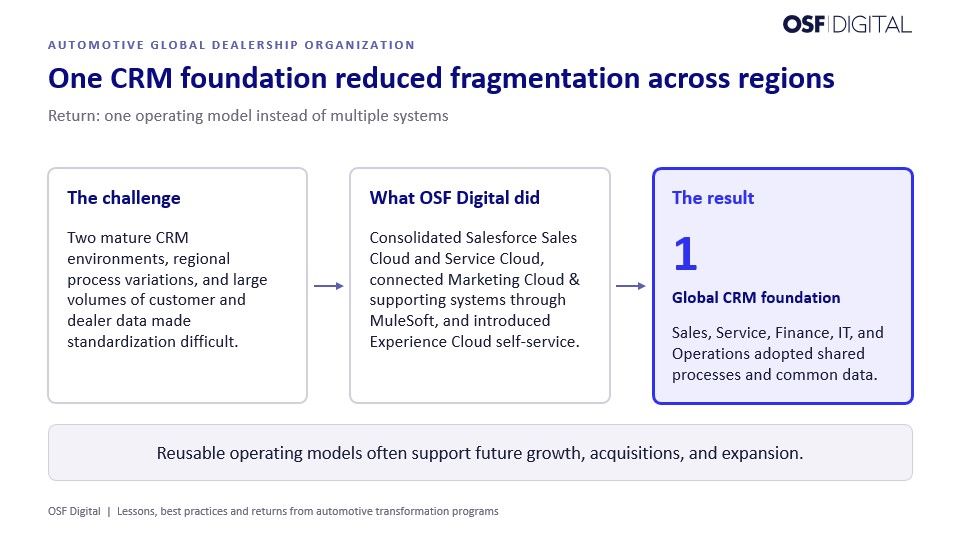
40,000 SKUs moved into one B2B ordering and subscription experience
The challenge: A global manufacturing and mobility organization managed subscription-based technical content through fragmented databases and manual workflows for fulfillment, returns, credits, renewals, and post-order service. Customers lacked self-service order tracking and automated status communication.What OSF Digital did: Agentforce Revenue Management, B2B Commerce, and MuleSoft connected Salesforce and SAP into a single purchasing and subscription environment. The program migrated 40,000 SKUs and added automated quoting, pricing, ordering, renewals, account controls, order history, tracking, and subscription visibility.The result: Multiple customer stakeholders gained a single experience across purchasing, subscription management, and account administration.Why it matters: Automotive portfolios can extend beyond vehicles and parts into technical content, subscriptions, and service entitlements. The same integration principles apply when product access, renewals, billing context, and customer visibility must survive across commerce, revenue, ERP, and support workflows. Read the story →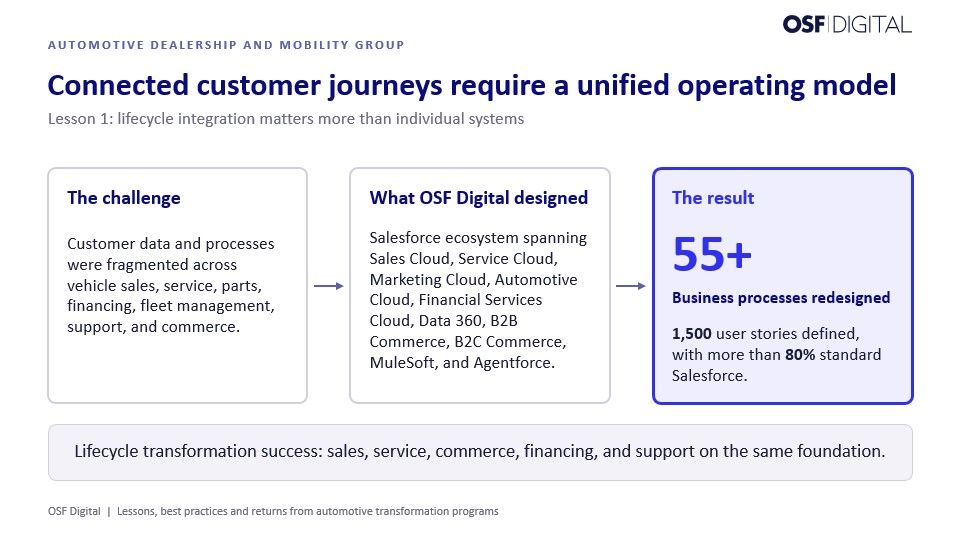
What do OSF’s automotive sales and aftersales programs show?
Automotive sales and aftersales integration programs show three business-value patterns: growth comes from connected journeys, scale comes from reusable operating models, and returns become credible when delivered capabilities are separated from planned expansion.Lesson 1: Connected journeys turn shared context into conversion and retention
The pattern: One regional program connected marketing, dealer engagement, sales, service, commerce, and preferred-channel communication across two markets. The connected journey produced documented improvements in conversion, retention, adoption, and operational profit, measured alongside program delivery.The lesson: The business case for integration is not a consolidated customer screen. The value comes from using the same customer, dealer, vehicle, campaign, sales, and service context across the moments that influence acquisition, conversion, retention, and cost to serve.What OSF Digital deployed: Sales, Service, Experience, Marketing, B2B Commerce, Automotive Cloud, MuleSoft, and WhatsApp integration created one cross-cloud operating pattern that connected customer engagement, dealer collaboration, commerce, and lifecycle communication.Lesson 2: Reusable foundations reduce the cost of expansion
The pattern: one program reused a regional framework across two markets. Another consolidated two mature CRM environments into one global Sales and Service foundation while preserving justified regional requirements. A third designed more than 55 business processes and 1,500+ user stories with more than 80% standard Salesforce functionality.The lesson: the first rollout creates more value when it produces a repeatable operating model for the next market, dealer group, acquisition, or business unit. Reuse reduces the need to redesign lifecycle stages, integrations, controls, reporting, portals, and adoption support each time the organization expands.What OSF Digital deployed: OSF Digital deployed a shared Sales and Service foundation, MuleSoft integrations, Experience Cloud self-service, Marketing Cloud capabilities, common workflows, migration, governance, and change support. In the regional program, the same cross-cloud framework was adapted to local market priorities rather than rebuilt from the beginning. Read the story →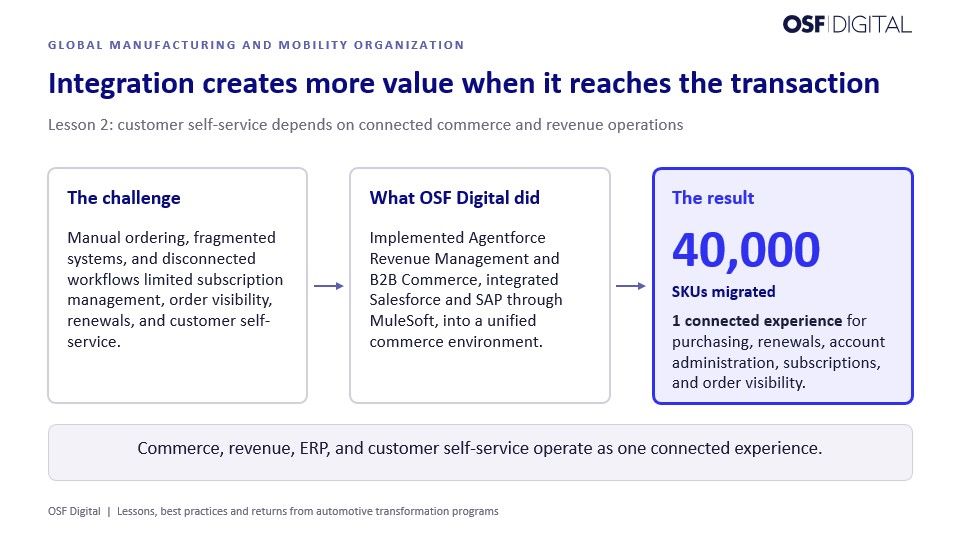
Lesson 3: New revenue and service experiences need operational depth
The pattern: the six programs extended integration beyond CRM. One field execution program supported a network serving more than 60,000 retail locations. One commerce and revenue program migrated 40,000 SKUs and connected ordering, subscriptions, renewals, and customer self-service. Another program placed six AI sales-coaching agents within opportunity work.The lesson: business value increases when integration reaches the transaction and service work around the customer. Mobile order capture, offline execution, subscription renewals, order visibility, product guidance, and financing support make the connected foundation useful for daily operations, not just for reporting.What OSF Digital deployed: OSF Digital deployed Consumer Goods Cloud Retail Execution with ERP integration and mobile and offline capabilities; Agentforce Revenue Management and B2B Commerce connected to SAP through MuleSoft; and six Agentforce sales coaching agents grounded in CRM data, knowledge articles, and business documentation.Which best practices does OSF apply in automotive sales and aftersales transformations?
Automotive sales and aftersales transformations create more value when they improve field execution, make self-service transactional, embed guidance in daily work, and scale proven capabilities in stages.Practice 1: Modernize field execution around the work that produces revenue
Field transformation should begin with the activities that directly affect coverage, order capture, product availability, and account growth. In the source program, a distribution network serving more than 60,000 retail locations adopted visit planning, account management, order capture, task prioritization, and mobile and offline execution. ERP integration kept field activity connected to operational data, while intelligent recommendations added guidance inside the visit workflow. Enhanced reporting, lead nurturing, advanced scheduling, and adaptable pricing remained on the roadmap rather than being presented as delivered results. Read the story →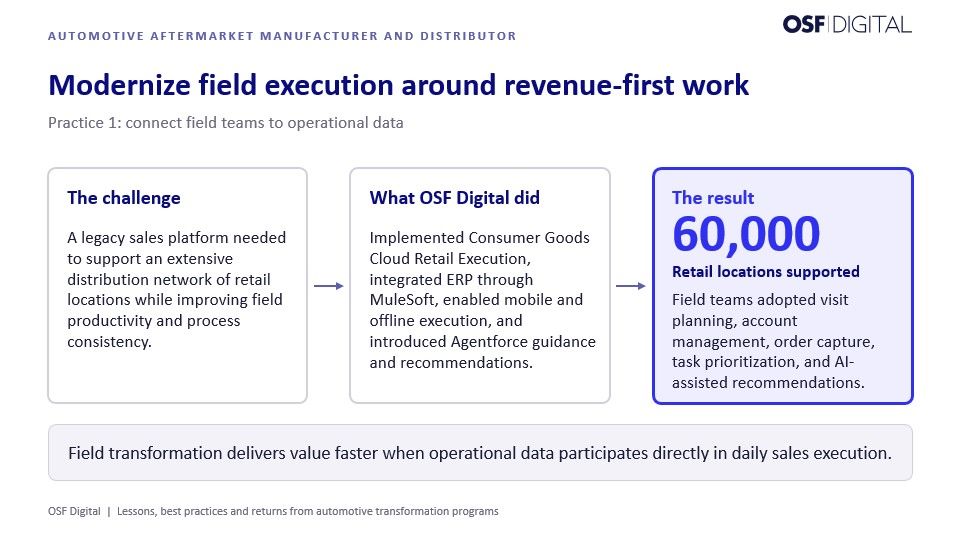
Practice 2: Make self-service part of the revenue and service journey
Automotive self-service creates value when customers and dealers can complete work, not only view information. Across the programs, Experience Cloud and B2B Commerce supported dealer collaboration, inventory visibility, purchasing, service access, customer information, order history, subscription status, renewals, and account administration. One program migrated 40,000 SKUs into an Agentforce Revenue Management and B2B Commerce environment connected to SAP via MuleSoft, creating a single experience for ordering, subscriptions, tracking, and post-order service.Practice 3: Embed AI guidance in high-value sales and service moments
Automotive AI produces practical value when guidance appears inside a specific decision. Six Agentforce sales coaching agents used CRM data, knowledge articles, and business documentation to provide next-best actions, competitive context, product recommendations, and financing support inside Sales Cloud. The program slide associates Salesforce support and optimization with higher ROI, sales, lead conversion, and NPS, as well as lower operational risk. Those outcomes remain directional because the source does not provide baselines, measurement periods, or attribution methods. Read the story →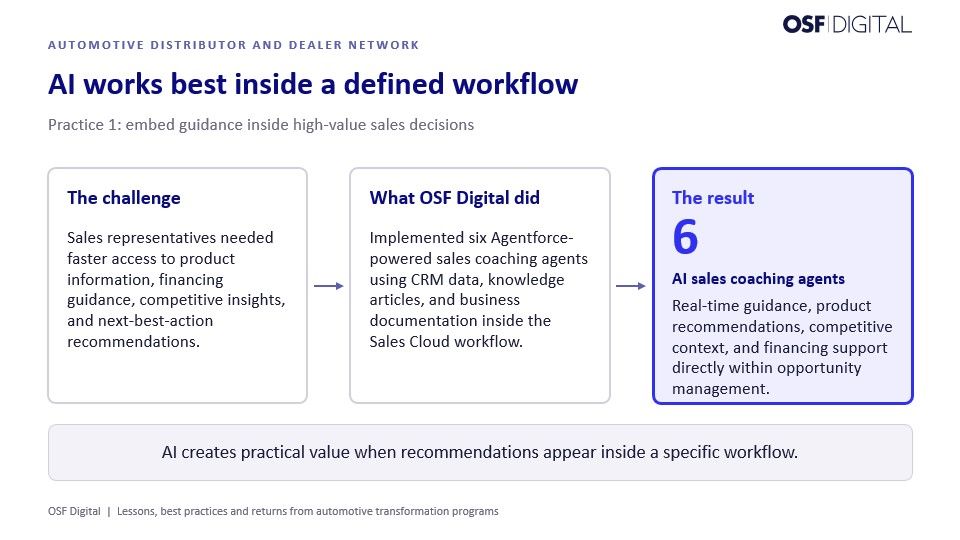
Practice 4: Scale the capabilities that prove adoption and value
Automotive transformation should expand from capabilities that users adopt and the business can measure. The programs show a practical sequence: establish the connected foundation, launch one bounded journey or operating model, measure active use and business change, and then extend the pattern to additional markets, channels, dealer groups, or functions. The South American program paired cross-cloud delivery with conversion, retention, campaign, adoption, and profit measures. The field execution program kept four roadmap capabilities separate from the four capabilities already delivered. That distinction protects the investment case and makes later expansion easier to prioritize.How can automotive leadership teams apply these lessons to their own operations?
Automotive leadership teams can apply these lessons by evaluating candidate journeys against business value, operational friction, measurable outcomes, and potential for reuse across markets and functions.Value and frictionAutomotive leadership teams should prioritize a journey that crosses organizational boundaries and creates measurable operational or commercial improvements. Strong candidates include lead-to-dealer, sales-to-service, delivery-to-first-service, field order capture, and service-to-renewal journeys.- Choose one transaction or handoff: lead-to-dealer, sale-to-delivery, delivery-to-first-service, parts self-service, field order capture, or service-to-renewal.
- Measure current friction: duplicate entry, unmatched identities, exception volume, cycle time, inbound contacts, missed commitments, dealer participation, and conversion or retention baseline.
Evidence and reusability
Automotive leadership teams should select a phase that produces evidence while creating data, workflow, and governance components that other markets, dealer groups, and business functions can reuse. Programs that create a repeatable operating model typically support broader transformation efforts more effectively than isolated implementations.- Score reuse: how many markets, dealer groups, channels, and functions can use the same data and workflow pattern.
- Set the evidence gate: delivered capability, active users, workflow completion, operational change, and financial attribution should have separate owners and dates.
- Draw the context contract: required records, authoritative source, update event, permissions, offline behavior, synchronization rule, and exception owner.
Final Thoughts
Automotive organizations risk losing customers when client and dealer information becomes fragmented across sales, service, parts, financing, commerce, and operational systems. A connected operating model helps preserve context throughout the customer lifecycle, allowing teams to make better decisions and deliver more consistent experiences.The most successful transformations start with a single high-value journey, establish clear ownership and governance, and connect the systems and processes that support it. By combining shared data, integrated workflows, self-service capabilities, and workflow-based intelligence, automotive organizations can create a scalable foundation that strengthens both customer relationships and operational performance across markets.


Frequently asked questions
Automotive companies do not need all records in a single system. The source programs kept ERP and other operational systems connected via MuleSoft, while Salesforce environments governed the customer, dealer, workflow, portal, and engagement contexts. Replacement is a separate decision based on whether a system can continue to own its transactions and meet integration, control, and service requirements.
The first process should cross an organizational boundary and have a measurable baseline. Strong candidates include the sales-to-service handoff, dealer lead management, parts and service self-service, field order capture, or service-to-renewal. The best first phase also creates data and workflow components that later markets or functions can reuse.
Automotive companies should standardize identity, lifecycle stages, controls, integration rules, and enterprise reporting in a global core. Regional patterns can serve markets with similar dealer and commercial models. Local exceptions should have a named owner, a business reason, a data impact, and a maintenance plan.
An automotive process is ready for AI when the task, approved data and knowledge, permitted recommendation or action, human review point, exception path, and quality measure are clear. One source program used six sales coaching agents within Sales Cloud, grounding their guidance in CRM data, knowledge, and business documentation.
Automotive leaders should separate technical delivery, active use, operational change, and financial impact. Useful measures include identity-match quality, handoff completion, exception volume, dealer participation, cycle time, service contacts, conversion, retention, and attributed profit. Every figure should include a baseline, a measurement period, an owner, and a mechanism.
An automotive integration working session should produce a selected journey, a lifecycle context contract, a global-core and local-exception map, a first-phase scope, and an evidence plan. The session should also record deferred capabilities and the conditions that would bring them into a later phase.
Automotive organizations can connect B2B ordering, subscriptions, and customer self-service by linking commerce and revenue workflows to ERP-held product, order, and account data. One source program used Agentforce Revenue Management, B2B Commerce, and MuleSoft to connect Salesforce and SAP, migrate 40,000 SKUs, automate ordering and renewals, and provide order history and subscription visibility within a single customer experience.
Automotive organizations should start with one cross-functional journey that combines business value, measurable outcomes, and reuse potential across markets, dealers, or business units. The six programs reviewed in this article show that integration creates the most value when the customer, dealer, service, commerce, and operational contexts support multiple functions rather than a single workflow.
 From Org Chaos to Operating Rhythm: Governing AI & Data at Scale
 Enhancing Ford’s Operations with Salesforce Multi-Cloud Solution