
Why Voice Belongs in Your CRMWhy Voice Belongs in Your CRMSchedule a meeting

The case for CRM-native voice in enterprise service

Most enterprise contact centers run voice in one system and customer data in another. The phone platform handles calls, routing, IVR, and recording. The CRM handles customer records, case history, and business logic. A connector sits between them.This model has worked for decades. It still works today for many organizations. But it carries structural limitations that become harder to ignore as service expectations rise and AI changes the picture.This article is not about choosing one vendor over another. It is about understanding what changes when voice becomes a native part of your CRM. And why that architectural shift matters for the next generation of service operations.

The Traditional Model: Voice and CRM as Separate Systems
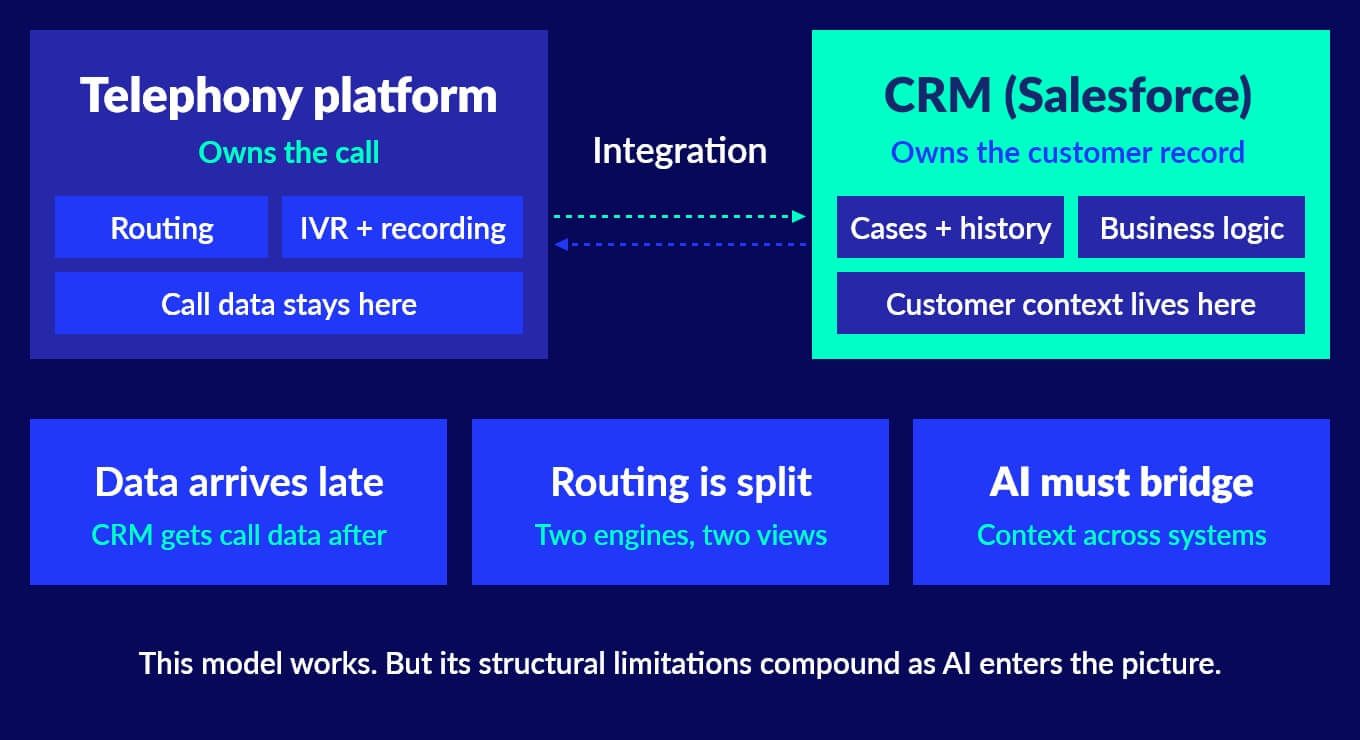
Diagram contrasting separate telephony and CRM platforms with integration issues and late data.
In a traditional contact center, the telephony platform is the center of gravity for voice. It owns the call. It decides where the call goes. It records the conversation. It tracks queue performance and agent availability.The CRM sits alongside it. When a call arrives, the telephony system passes basic data to the CRM through an integration layer. The agent sees a screen pop with the customer record. When the call ends, a summary gets logged. Reports are built by stitching together data from both systems.This works. Millions of service interactions happen this way every day. But it creates three structural realities that are worth examining honestly.Voice data arrives late and incompleteIn an integrated model, the CRM receives call data after the telephony system processes it. The integration passes what it is configured to pass. Caller ID, queue name, maybe a disposition code. The rich detail of the conversation, the transcript, the sentiment, the specific language the customer used, typically stays in the telephony system or arrives later through a batch sync.For human agents, this is manageable. They were on the call. They know what happened. For AI, automation, and analytics, this lag matters. The system that holds the business logic does not have real-time access to the richest signal in the interaction: the conversation itself.Routing logic lives in two placesWhen voice and digital channels are managed by different platforms, routing decisions are made by different engines. The telephony system routes calls based on its own queue logic, skill groups, and availability rules. The CRM routes chats, emails, and cases through its own framework.In practice, this means an agent can appear available in one system and busy in another. A customer calling about an open case might be routed based on telephony queue logic rather than CRM case context. Supervisors monitor performance across two dashboards with two sets of definitions.This does not break operations. But it introduces friction that compounds as interaction volumes grow and channel blending becomes more common.AI has to reach across systems for contextThis is where the structural limitation becomes most visible. AI capabilities like real-time agent guidance, automated summaries, intent detection, and autonomous resolution all require access to both the live conversation and the customer record at the same time.When voice data lives in one system and customer data lives in another, AI has to bridge that gap in real time. This is technically possible. But it adds latency, complexity, and integration surface area. Every additional API call introduces a point of failure. Every data transformation introduces a risk of context loss.Organizations that want to use AI in service often find themselves building a parallel data layer just to give the AI enough context to operate. That is a solvable problem, but it is also avoidable if the architecture is designed differently from the start.

What Changes When Voice Is Native to the CRM
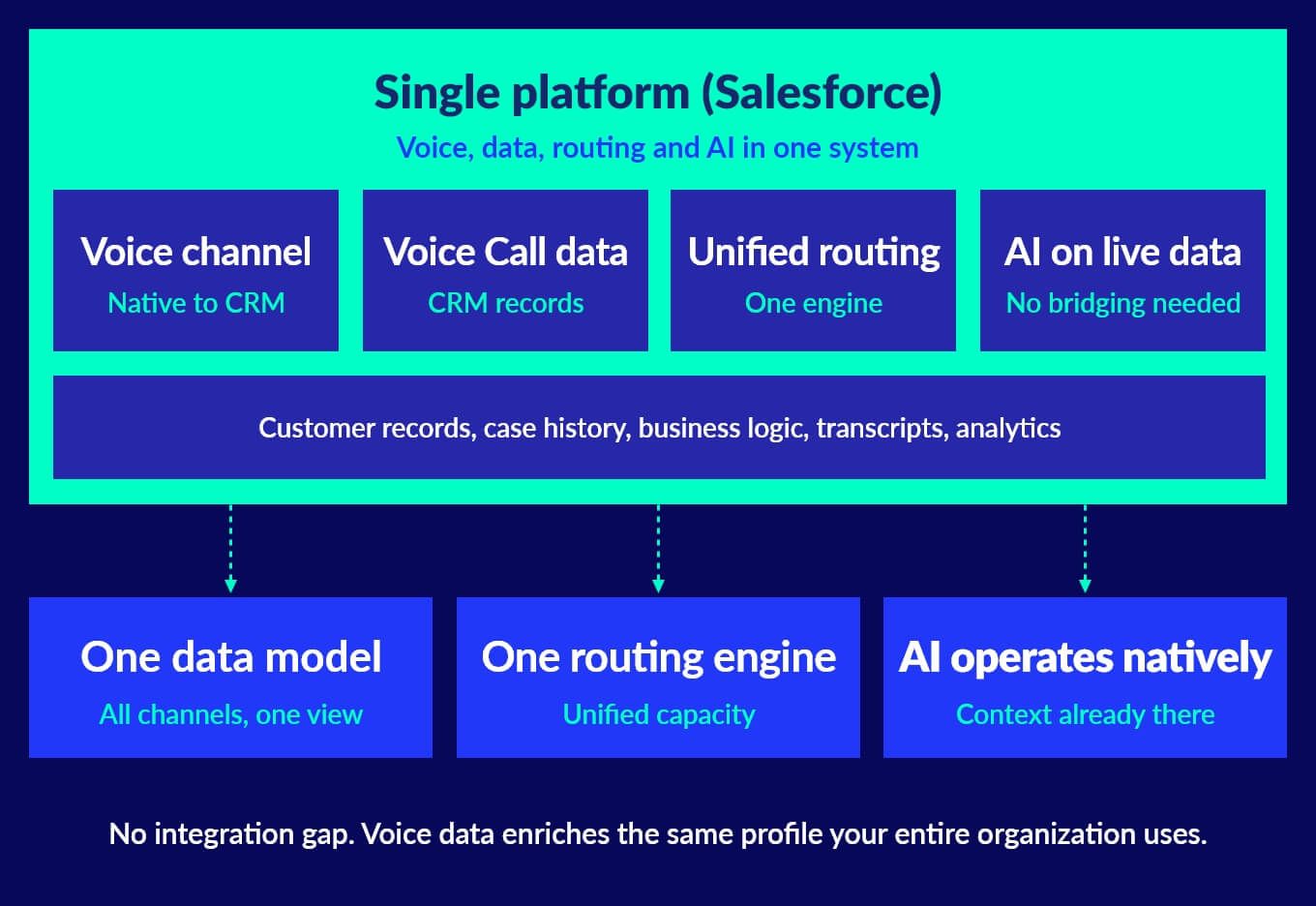
Diagram illustrating Salesforce as a single platform for voice, data, routing, and AI.
CRM-native voice means the call itself becomes a first-class CRM record from the moment it begins. Not after the call. Not through a sync. From the first ring.On Salesforce, this is what Service Cloud Voice (now called Salesforce Voice) enables. The call enters Salesforce directly. A Voice Call record is created as a standard Salesforce object. Transcription happens in real time within the platform. Routing is handled by the same engine that manages chat, email, and messaging. The agent works in a single console for all channels.This changes the operating dynamics in several practical ways.One data model for all channelsVoice interactions, chat transcripts, email threads, and messaging conversations all produce records in the same system. Reporting does not require data stitching. A supervisor can see handle time, resolution rate, and customer satisfaction across every channel in one view, using one set of definitions.For analytics teams, this eliminates one of the most persistent problems in contact center operations: reconciling metrics from different platforms that define the same thing differently.One routing engine for all interactionsWhen voice joins the same routing framework as digital channels, capacity management becomes unified. An agent handling a complex call is recognized as busy across all channels. A customer with an open high-priority case can be routed to the assigned agent regardless of whether they call, chat, or send a message.This also simplifies workforce planning. Instead of managing separate skill groups and availability pools across two systems, teams work with one model.AI operates on live, native dataThis is the most consequential shift. When the call transcript, the customer record, the case history, and the business rules all exist in the same platform, AI does not have to reach across systems to assemble context. It already has it.Real-time agent guidance can read the live transcript and surface relevant knowledge articles without an API call to an external system. Automated call summaries can write directly into case records. Intent detection can trigger workflows using native automation. Autonomous agents can resolve straightforward issues using the same data and logic that human agents use.This does not mean AI is impossible in a separated architecture. It means CRM-native voice removes a layer of integration complexity that AI otherwise has to work around.

You Do Not Have to Replace Your Telephony to Get There
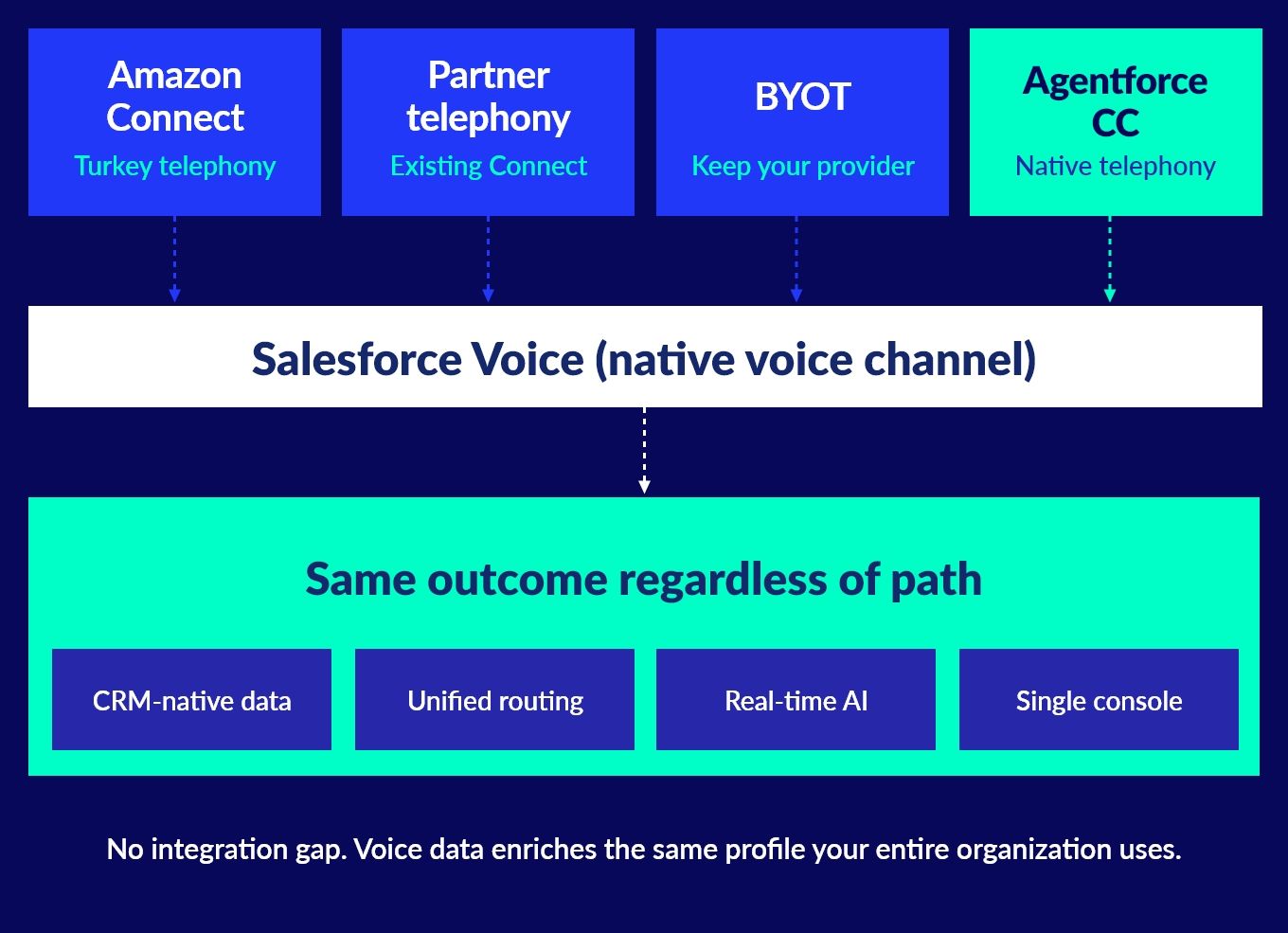
Salesforce Voice native channel diagram showing connectivity of telephony options to unified CRM data.
A common misconception is that CRM-native voice requires abandoning your existing telephony provider. It does not.Salesforce Voice supports multiple deployment models. You can use Amazon Connect as a turnkey telephony provider. You can connect an existing Amazon Connect instance. Or you can bring your own telephony through the Partner Telephony framework, keeping providers like Genesys, NICE CXone, Cisco, or others in place.In all three models, the outcome is the same. Voice becomes a native Salesforce channel. Calls produce standard CRM records. Routing is unified. AI has direct access to conversation data.The telephony provider continues to handle what it does well: carrier connectivity, dial tone, and call quality. What changes is where the data lands, where routing decisions are made, and where intelligence is applied.For many organizations, this means starting with a Bring Your Own Telephony approach. You modernize the agent desktop, the data model, and the AI layer first. The telephony consolidation decision can come later, based on results rather than assumptions.

The Strategic Question Behind the Technical One

The choice of where voice lives in your architecture is ultimately a question about where you want intelligence to accumulate.If voice stays in a separate platform, the intelligence that platform generates stays there too. Call analytics, quality scores, and interaction patterns remain in a silo that has to be connected to your customer data through integration.If voice moves into the CRM, every call enriches the same customer profile that your sales, marketing, and service teams already use. A call about a billing issue becomes a data point that informs a renewal conversation. A support interaction where the customer mentions a competitor becomes a signal for the account team. A pattern of repeated contacts becomes visible to the operations leader managing capacity.This is not about replacing one vendor with another. It is about deciding where the richest signal in your customer relationship, the live conversation, should live and compound.

Where This Fits in the Broader Service Transformation

CRM-native voice is not the destination. It is the foundation.Once voice data lives natively in Salesforce, a series of next steps become available. Agentforce can deploy autonomous voice agents that handle routine interactions before a human is involved. Service Rep Assistant can guide agents in real time using the live transcript and full customer context. Automated quality monitoring can score every interaction, not just a random sample. Predictive models can identify at-risk customers based on conversation patterns across all channels.None of these capabilities require voice to be native. But all of them are simpler, faster, and more reliable when it is.For organizations already exploring how AI can improve service operations, the question is not whether to adopt AI. It is whether the infrastructure underneath supports it efficiently or requires workarounds to compensate for architectural separation.

How OSF Digital Helps

At OSF Digital, we help organizations evaluate where voice should sit in their service architecture and design a transition path that fits their current environment.We start by understanding your current stack, your service goals, and where the friction is. From there, we design a Salesforce Voice approach that preserves business continuity, removes legacy risk, and creates a clear path to AI-enabled service.Whether you are migrating from Open CTI, evaluating Salesforce Voice deployment models, or planning your first Agentforce use case, we can help you sequence the work so that each step delivers value on its own.Ready to explore what CRM-native voice could look like for your organization? Contact OSF Digital for a personalized assessment.
Contact: Kateryna Melkomukova
Sign up for the latest news, trends and insightsSUBSCRIBE

BROWSE AND READFor More On This Topic
How AI First Service Turns Every Interaction Into Revenue, Retention, and Lifetime ValueHow AI First Service Turns Every Interaction Into Revenue, Retention, and Lifetime Value
Blog
See how AI-first service boosts retention, revenue, and loyalty by turning every customer interaction into a moment of value through intelligence and orchestration.Read more

The Agentic Service RoadmapThe Agentic Service Roadmap
Blog
See how AI will resolve 50% of cases by 2027. Explore the agentic service roadmap with OSF Digital.Read more
Brochure cover: 'From Contact Center to Agentic Service Engine' by OSF Digital.From Contact Center to Agentic Service Engine
White Papers
Discover how AI-ready architecture, autonomous agents, and multi-agent collaboration transform service operations into intelligent execution engines—reducing costs, accelerating resolution, and closing the execution gap.Read more