

What is Salesforce Headless 360?
Salesforce Headless 360 is an architectural direction that makes the capabilities you already own reachable without a browser. Data, workflows, business logic, and approvals can be called directly by AI agents and other systems through APIs, Model Context Protocol tools, and command line interfaces, rather than requiring a person to log in and click through a screen.According to Salesforce's product documentation, the release includes more than 60 MCP tools and more than 30 prebuilt skills. In its August 2026 announcement, Salesforce expanded that further with additional MCP servers across Marketing, Sales, Service, Commerce, MuleSoft, and Informatica, and a repository of more than 100 reusable skills.This builds on something Salesforce has been doing for a long time. As Salesforce noted in the same announcement, it pioneered the enterprise web API more than 27 years ago, making data and functionality available beyond a single application. Headless 360 carries that principle into the agentic era.Nothing is being taken away. Salesforce has stated directly that Lightning components and browser experiences are not going away.For the full explanation of the terms and architecture, see our guide to Salesforce Headless 360.What does Salesforce Headless 360 change about how work gets done?
Until now, most of the value in Salesforce was triggered by a person. Someone logged in, checked a queue, worked a record, and moved the process to the next step. Even where automation existed, the sequence usually started with a human opening the application.That is the constraint Headless 360 removes. The same data, the same rules, and the same approvals can now be reached from wherever the work already happens: a messaging thread, a voice conversation, a field application, a customer portal, or an AI agent acting on your behalf. The platform still does the work. Nobody has to open it first.The practical effect is that the return on what you have already built stops being capped by how often someone logs in. A workflow you configured years ago can now run in more moments, on more surfaces, without being rebuilt for each one.Some organizations are already operating this way. Salesforce reports that Engine built and launched its AI support agent in twelve days, and that the agent now resolves half of the company's customer chat interactions without a person on the line.Why should you start with a single process on Salesforce Headless 360?
Because that is what separates the organizations that get to production from the ones that stay in exploration.The pattern is consistent across platform shifts. Broad initiatives without a named process tend to produce architecture diagrams. A single process with a measure attached produces a result somebody can point at, and a result somebody can point at is what funds the next five.So the first question is not how much of the platform to expose. It is which one process is worth proving it on, and what would count as proof.Which Salesforce Headless 360 starting point are you at?
Headless 360 works by making what you already have reachable from more places. That means the state of what you already have shapes how fast a first project moves.Two starting points: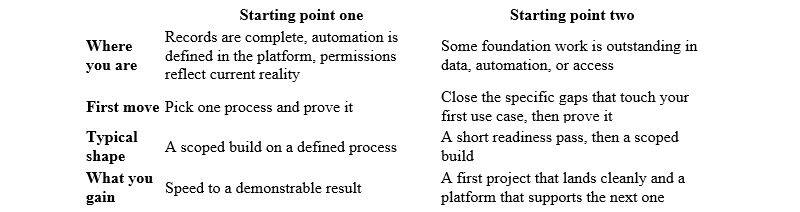
When should you prove Salesforce Headless 360 on a live process?
If your foundation is in good shape, the fastest route is a scoped build on a single process with a defined measure.Four signs you are here:- You are rebuilding the same logic across channels. Every new portal or app recreates rules you already have, which is the clearest case for a shared layer.
- Work is happening outside Salesforce and getting recorded afterward. Messaging platforms, field apps, and partner portals are where the value shows up first.
- An agent deployment is already on the roadmap. Agents cannot navigate screens, so the architecture question is already in front of you.
- You can name the process. Not a category. One process, with a measure, that somebody owns.
When should you strengthen your foundation before Salesforce Headless 360?
If some groundwork is outstanding, the fastest route is to close the specific gaps that touch your first use case, then build. This is not a delay. It is the difference between a first project that lands in weeks and one that stalls in discovery.Four things worth confirming:- What your permission model currently allows. Permissions become the control layer for anything acting on its own, so it pays to know what they permit today rather than what they were designed to permit.
- Where your data has gaps. Start with the fields your team works around. Those are the ones an agent will surface first.
- Which process logic lives in habit rather than in the system. Rules the platform enforces are rules an agent can follow.
- How well your metadata describes your business. Field names, descriptions, and clear picklists are how anything automated interprets your data.
Who should be in the room for a Salesforce Headless 360 decision?
Headless 360 touches architecture, process, security, and spend. Four perspectives make the first conversation productive:
Where to start
The practical next step is a conversation about two things: which process is worth proving this on, and what sits between you and that first build.Talk to OSF Digital about where Salesforce Headless 360 fits in your roadmap, and we will help you find your first process and the fastest route to proving it. Also, we can help you strengthen your foundation to get you to the point where your organization is ready for Salesforce Headless 360.Salesforce Headless 360 frequently asked questions
What is Salesforce Headless 360?Headless 360 is an architectural direction that exposes Salesforce capabilities through APIs, MCP tools, and CLI commands, so AI agents and other systems can act on your data and workflows without a person opening a browser. Salesforce describes it as making trusted business capabilities reusable wherever AI works.Where should we start with Headless 360?With one process and one measure. Identify a process where work is currently duplicated across channels or happening outside Salesforce, define what success would look like numerically, and scope the first build around that. Broad initiatives without a named process are harder to fund and harder to prove. OSF Digital can help you regarding Salesforce Headless 360, how Salesforce Headless 360 fits in your roadmap. OSF Digital will help you find your first process as a Salesforce Headless 360 use case and the fastest route to proving it. Also, we can help you strengthen your foundation to get you to the point where your organization is ready for Salesforce Headless 360.Do we have to buy something to use Headless 360?Headless 360 is an architectural direction across the platform rather than a single purchase, and components carry different availability. What applies to your organization depends on your existing licensing and which components your use case needs, so it is worth confirming against your current agreement.Does this mean our team stops using Salesforce?No. Salesforce has stated that Lightning and browser experiences are not going away. Headless 360 adds ways to reach the platform rather than replacing the existing one.Is Headless 360 secure?Agents inherit the identity, permissions, sharing rules, and compliance controls already defined in your org, which is a substantial protection and one of the reasons building on an established platform differs from assembling this yourself. It also means the current state of your permission model shapes what agents can do. Permissions determine what an agent can reach. How much a single action can affect is a related design question worth raising early with your security team.Do we need Data 360 to use Headless 360?Not necessarily. It depends on whether your first use case needs data that lives outside Salesforce. A project scoped to standard Salesforce objects can typically proceed without it.How is Headless 360 different from the APIs we already use?It extends them. Salesforce has offered enterprise APIs for more than 27 years, and Headless 360 broadens what is exposed, adds MCP as an open standard that AI agents can use to discover and understand available capabilities, and packages business logic into reusable skills that carry your governance with them.Which components should our first project use?That depends on the use case, and it is worth asking early. Salesforce publishes availability for each component, including which are generally available and which are in open beta. Matching your first project to the right components is a scoping decision that affects timeline more than most people expect. OSF Digital maps your intended use case against current component availability, so the scope you agree to is built on what is stable enough to support it.How long does a first Headless 360 project take?A single, well-defined process with a clear measure is typically a matter of weeks rather than months. OSF Digital runs first Headless 360 engagements as fixed-scope builds on one predefined use case, with the deliverable, the timeline, and the exclusions agreed before work starts.What if our data is not fully in shape?Then close the gaps that touch your first use case rather than all of them at once. Targeted readiness work is usually shorter than a full remediation program, and it improves what you have today either way. OSF Digital assesses readiness across data, automation, and access, then identifies the specific gaps standing between you and your first use case.Contact: Kateryna Melkomukova
Sign up for the latest news, trends and insightsSUBSCRIBE


 Overcoming AI Innovation Abandonment: Moving from Traditional Multi-Cloud Projects to Outcome-First MVPs
Most enterprises don’t fail at AI because the technology doesn’t work. They fail because their delivery models weren’t designed to succeed. This whitepaper explains how to break the cycle — and what it takes to move from stalled pilots to production-ready AI at scale.Download
 This Is Not Another Technology Cycle: An Executive Point of View on the Agentic Enterprise
Pilots are succeeding. Scale is not following. The narrative coming from AI platforms, global integrators, and AI-native specialists is contradictory by design. This paper sets out the honest view: where enterprises actually are after two decades of automation, why 60 to 70 percent of priority process work is still human-executed, and what the agentic enterprise actually requires from your operating model, your architecture, and your delivery approach.Download
 The Framework for the Agentic Enterprise: Moving from Manual Tasks to Deterministic Workflows
Most enterprises have the systems. They are still missing the execution. This whitepaper lays out what it takes to move from shadow processes to autonomous, auditable workflows and why the window to act is narrowing.Download