

Key takeaways
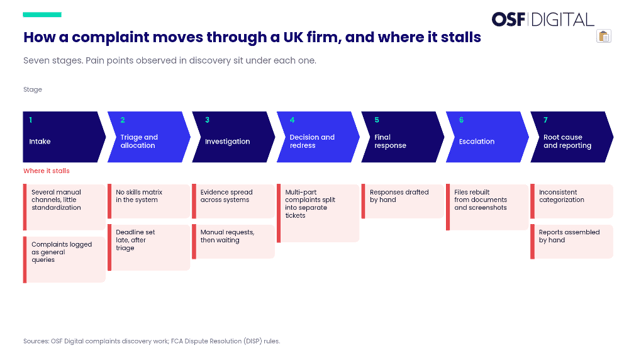
- UK complaint volumes have not moved in five years. They have stayed between 1.7 and 2.0 million every half-year since 2021, through Consumer Duty, automation programs, and a rise in AI adoption from 58% to 75% of firms.
- Most complaints are not disputes. UK firms upheld between 55.5% and 57.9% of the complaints they decided in 2025, which makes each one a confirmed finding about a product, a price, a process, or a letter.
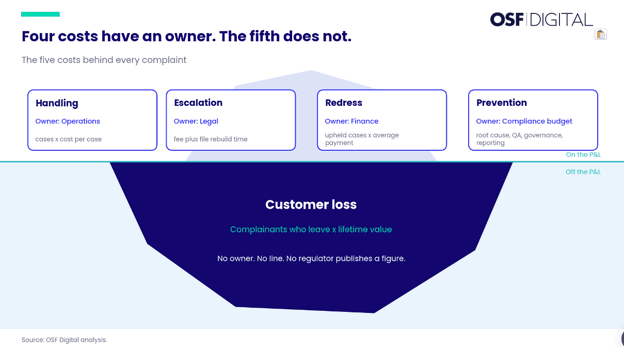
- A complaint creates five costs, and four of them have an owner. Handling sits with Operations, Ombudsman escalation with Legal, redress with Finance, prevention inside a compliance budget. Customer loss usually has no owner and no line.
- The January 2027 FCA return raises the bar on complaint data, not just on reporting. It assumes complaints are identified consistently, categorized at capture, and recorded in fields a report can count.
- Where you start depends on your constraint. Four paths, each with one lead indicator: fix the case record, take retrieval out of the handler's day, cut Ombudsman escalation cost, or send the complaint signal upstream.
Why hasn't five years of technology investment moved UK complaint volumes?
Five years of automation programs have not moved UK complaint volumes, which have stayed between 1.7 and 2.0 million in every half-year since the start of 2021, according to FCA aggregate complaints data UK firms received 1.83 million complaints in the first half of 2025 and 1.74 million in the second.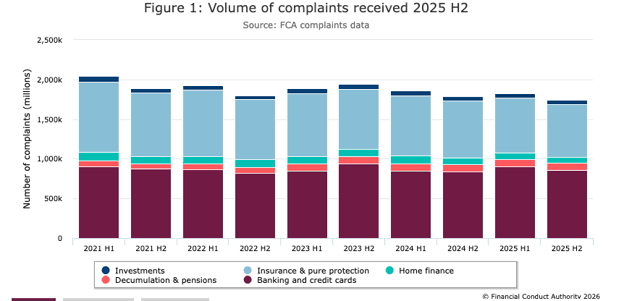
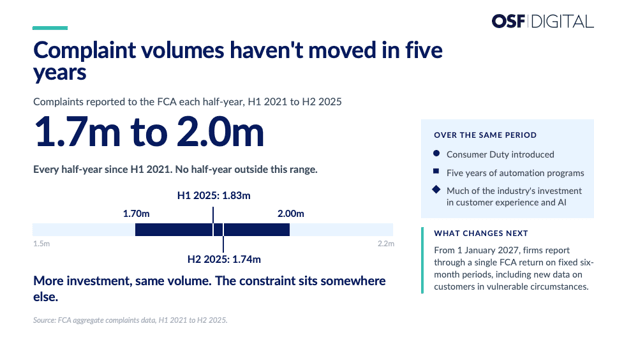
How a complaint moves through a firm
A complaint passes through seven stages. Each one creates cost, and each has a point where work tends to stall.- Intake. A customer raises a concern in a branch, on a call, by email, in chat, or on social media. A colleague decides whether it counts as a complaint, and that decision starts the regulatory clock. Logged as a query instead, it never reaches the reported numbers.
- Triage and allocation. The complaint gets a category and an owner. The category sets the deadline, and payment services complaints run on a much shorter one.
- Investigation. Part judgment, part retrieval: transaction histories, documents from other teams, and a chronology built from several systems.
- Decision and redress. The firm reaches an outcome and pays anything owed.
- Final response. The decision, the reasons, the evidence relied on, and the customer's right to refer the case to the Financial Ombudsman Service.
- Escalation. If the customer is not satisfied, or eight weeks pass without a final response, the case can go to the Ombudsman.
- Root cause and reporting. Categories applied at intake feed thematic analysis and the FCA return.
What sits beneath the volume
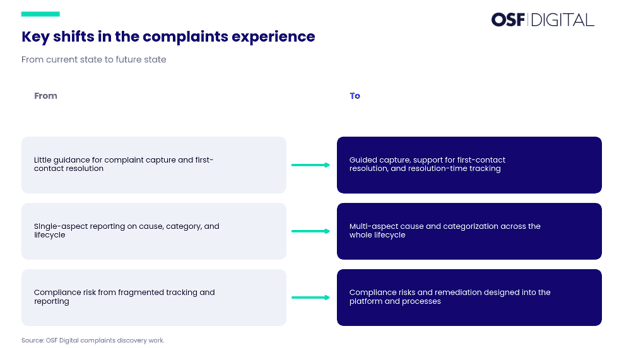
Firms upheld between 55.5% and 57.9% of the complaints they decided across the two 2025 half-years, according to the FCA.That changes what a complaints function is. Most complaints are not disputes. They are cases where the firm investigated, agreed the customer was right, and paid."When a firm upholds more than half the complaints it decides, those are not disputes. They are your own customers telling you, at no cost, exactly what to fix. The firms that get ahead are the ones who treat that as research rather than as a queue to clear."Karman Singh, Experience Led Solutions through Salesforce | Sales Director - Financial ServicesTake a firm handling 20,000 complaints a year with an uphold rate of 57%. That is roughly 11,400 confirmed findings a year about its own products, pricing, communications, and processes, identified by customers at no research cost. In many firms, those findings end in a case closure record. Product, pricing, and underwriting teams rarely see them. Neither does the team that wrote the letter that prompted the complaint. There is a second layer. Recording complaints too narrowly at the front line is a recurring supervisory theme: complaints logged as general queries never reach the reported numbers or the root cause data. A complaint volume that looks low for a firm's size and product mix is not a result the regulator will credit. It is a question the regulator will ask.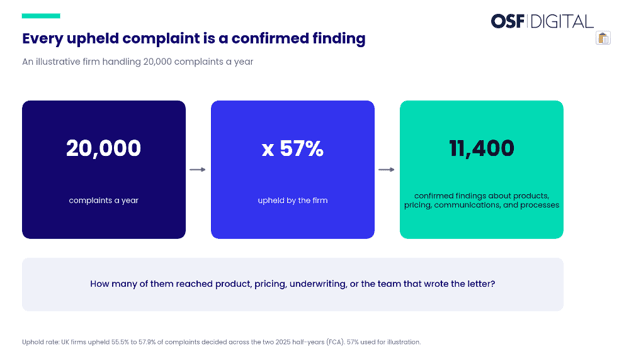
The five costs of a complaint
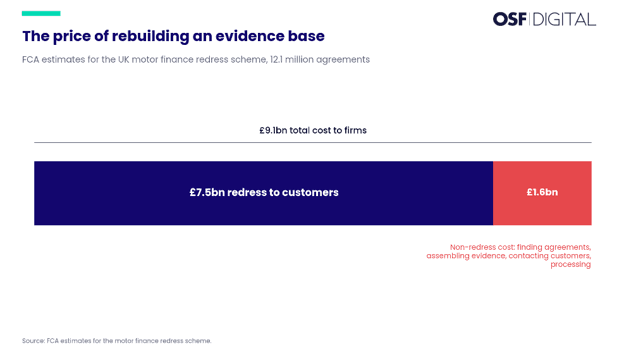
Four of the five costs have an owner. Handling usually sits with Operations, escalation with Legal, redress with Finance, and prevention inside a compliance budget. The fifth, customer loss, has no owner and no line.HandlingCost per case, multiplied by volume.Handling cost tends to rise with headcount because retrieval scales with volume. Every extra handler sends more requests to the same upstream teams, so the queue moves into departments that do not appear on the complaints dashboard. Cycle time stays roughly where it was.Average handle time will not show this, because it does not separate time spent deciding from time spent fetching.Ombudsman escalationThe case fee, plus the staff time to rebuild the file.For 2026/27, the Financial Ombudsman Service charges a case fee of up to £680 once a business has used its £2,000 annual allowance, which replaced the previous free cases allowance. Firms pay the fee on investigated cases whatever the outcome. It falls to £500 where a professional representative brought the case and the complaint is not upheld.Staff time usually costs more than the fee. Where a file was never held in one place, someone has to rebuild it, often while handling live cases.That makes the escalation rate one of the most controllable lines in the stack, because it responds directly to how early and how completely a case is resolved. One comparison is worth running: the Ombudsman publishes complaint data by business, including how often it finds in the customer's favor. If that rate is noticeably higher for your firm than for your sector, some cases that could have been resolved internally are reaching escalation instead.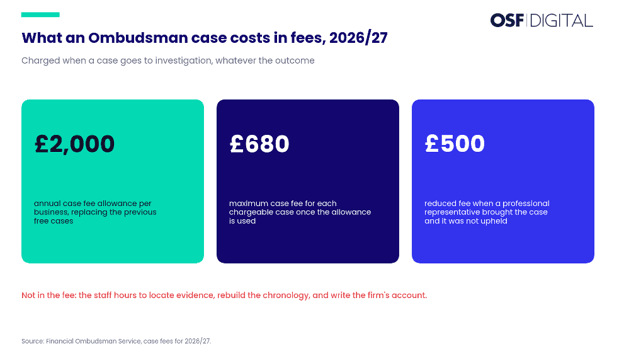
Fewer complaints, and a better recovery when one happens
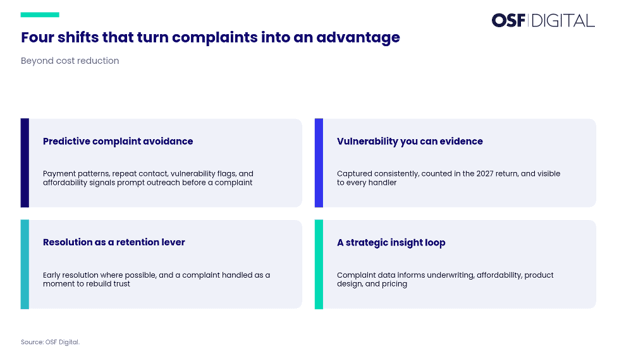
Lowering cost per case is half the opportunity. The other half is reducing how many complaints happen, and handling the ones that do in a way that keeps the customer."A complaint is the moment a customer decides whether to stay. Get it right and switching starts to feel like a downgrade. Get it wrong and they have already gone, whatever the final response says."Karman Singh, Experience Led Solutions through Salesforce | Sales Director - Financial ServicesPrevent where you can. Payment patterns, repeat contact attempts, vulnerability flags, and affordability signals can point to customers likely to complain before they do. A proactive conversation at that point costs less than any stage that follows.Resolve early where you can. A complaint resolved to the customer's satisfaction by close of the third business day can close with a summary resolution communication instead of a full final response. It still counts in reported numbers, but most of the follow-on cost falls away.Recover well when it matters. For the customer, a complaint is the moment trust is tested. A handler who sees the full history, including any vulnerability, and can resolve every part of the complaint in one response turns that moment into a reason to stay. The same complaint data can then inform underwriting, affordability, product design, and pricing, so the issue does not return.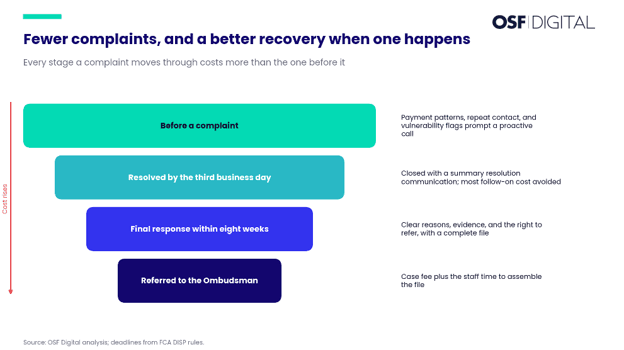
Where to start
Automating a process or bringing agentic AI into a process is an economic decision before it is a technical one, so the current cost needs to be known first. The sequence matters too: outcomes first, then people and process, then technology. In reverse, with technology first, the sequence tends to produce tools that change very little.There are four paths. Which comes first depends on where your constraint sits, what you can invest, and what else competes for the same people."Most firms already have the building blocks. What is usually missing is the sequence: agree the outcome you want, fix the process around it, then bring the technology. Do it the other way round and you automate the same problem faster."Karman Singh, Experience Led Solutions through Salesforce | Sales Director - Financial ServicesFix the case recordIntake runs through one front door, so a complaint received by phone, email, chat, or social media enters the same queue on the same clock. The complaint is classified at capture, so the right deadline, including the 15 business day payment services deadline, is set on day one. Multi-part complaints stay linked as one record with consolidated redress, and skills-based routing sends each case to a handler with the right product knowledge.What delivers it: Service Cloud for omnichannel intake, routing, knowledge, and SLA timers, together with the complaint management data model in Agentforce Financial Services, formerly Financial Services Cloud.Take retrieval out of the handler's dayFetching, chasing, and file assembly move out of the handler's work, and the decision stays with them. Evidence is gathered as the case runs, and people step in where judgment is needed and at exceptions.What delivers it: Agentforce Operations to orchestrate the work around the case and record each agent and human action, Agentforce inside the case for summaries, next best action, and response drafts, and MuleSoft for governed access to the systems where evidence lives.Cut Ombudsman escalation costFewer cases escalate, and those that do produce a file by export rather than reconstruction, because the audit trail was built during the case. Stronger final responses also reduce how many customers escalate in the first place.What delivers it: a timestamped record of each action across the case, with the case history, linked aspects, and redress held together in Agentforce Financial Services.Send the signal upstreamConsistent categories make root cause analysis repeatable. Confirmed findings reach product, pricing, and underwriting, the list of complainants reaches the retention team, and the FCA return comes from the same data the operation runs on.What delivers it: Data 360 to connect complaint records with product, transaction, and servicing data, Tableau for thematic reporting and board MI, and Marketing Cloud for complaint-informed retention outreach.This path usually takes longest because it crosses functions and depends on the categorization discipline from the first path. Firms that already tag consistently can start here.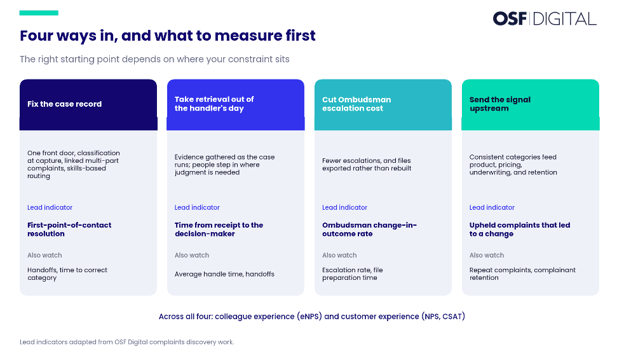
Questions worth asking internally
- Across your last hundred complaints, how many days passed between receipt and the case reaching the person who decided it?
- What share of your payment services complaints received a final response within 15 business days?
- When a case goes to the Ombudsman, is the file exported from one system or rebuilt from several?
- Of the complaints you upheld last quarter, how many changed a product, a process, or a price?
Start with the number
If you cannot yet state what a complaint costs your firm across all five lines, that is the first piece of work, and it is a short one. OSF Digital walks through each calculation with your own figures. We will look at your volumes, escalation rate, uphold rate, and cycle time, and suggest which path would move those numbers fastest in your environment.We work with firms on complaints through three entry points. A Lab is a two-day executive co-creation workshop for when the organization knows complaints is a problem but has not yet agreed which one. Navigator is a four- to six-week advisory engagement that produces a roadmap sequenced against your own priorities. The Complaints Accelerator is prebuilt complaints capability that shortens the build where requirements are close to standard.If you are making the case internally to turn complaints into opportunities for business growth, we can help you build it. Contact our team.OSF Digital is an AI-forward, data-driven, Salesforce-centric consulting services company, and a Salesforce partner since 2010. We have a 4.83 out of 5 satisfaction rating with our clients. We work with UK financial services firms on complaints management, service transformation, and data foundations across Agentforce, Financial Services Cloud, Service Cloud, and Data 360, and across the systems that sit around them, from integration and telephony to the data platforms where evidence lives.. We combine deep technical expertise, industry insight, and a distinctive partnership mindset to simplify complexity and deliver real business value, from advisory through implementation to managed services.


Frequently asked questions
The four levers are classification at capture so deadlines are set on day one, removing evidence retrieval from the handler's work so time goes on deciding rather than fetching, resolving cases early enough to avoid Ombudsman escalation, and sending confirmed findings upstream so the same complaint stops recurring. Each has one lead indicator: first-point-of-contact resolution, time from receipt to the decision-maker, the Ombudsman change-in-outcome rate, and the number of upheld complaints that changed a product, process, or price.
Referrals fall when cases are resolved earlier and final responses explain the decision, the reasons, and the evidence clearly. The second lever is the file itself: where the audit trail is built during the case, a referral is answered by export rather than reconstruction, which removes the staff hours that usually cost more than the £680 case fee.
Yes. Financial Services Cloud includes a complaint management data model, and Service Cloud provides omnichannel intake, skills-based routing, and SLA timers for regulatory deadlines. OSF Digital, a Salesforce partner since 2010, implements complaints management for UK financial services firms across these products, including root cause reporting and the FCA return.
Discovery typically takes six to eight weeks and produces process maps, personas, prioritized pain points, prototypes, user stories, and a solution design. Build time depends on scope, integrations, and how much of the evidence a handler needs sits outside the CRM today. Firms preparing for the FCA's January 2027 return usually start with categorization and vulnerability capture, since those inputs have to be in place before the first reporting period opens.
 Agentforce Operations
 Financial Services
 Trailblazing Growth Aag And OSF Digital Partner To Transform Financial Services And Fleet Operations