

Key takeaways
- Every firm has a complaints problem of some kind. Volumes are flat or rising in every market with published data. UK complaints have held between 1.7 and 2.0 million every half-year since 2021. German complaints to the regulator rose by about a third in a single year.
- Volume is the symptom, not the problem. Regulators in four markets found the same root cause: firms do not identify and record all complaints consistently, so the data that would prevent the next complaint never exists.
- A complaint creates five costs, and four of them have an owner. Handling, escalation, redress, and prevention each sit with a function. Customer loss usually sits with nobody.
- What escalation costs depends on your market's funding model, and each model rewards something different: fewer escalations, earlier resolution, a met deadline, or a response written for the public record.
- Prevention is the line most often cut and the one that reduces the other three. The UK motor finance scheme shows the price of rebuilding evidence after the fact: about £1.6 billion on top of £7.5 billion in redress.
Does every financial services firm have a complaints problem?
In some form, yes. Volumes are not falling anywhere with published data, and in several markets they are climbing. UK firms received 1.83 million complaints in the first half of 2025 and 1.74 million in the second, inside a 1.7 to 2.0 million band that has held every half-year since 2021, according to FCA aggregate complaints data. Australia's ombudsman received 100,745 complaints in 2024-25, the second year running above 100,000. Canadian banks reported nearly 269,000 complaints to their regulator in 2024-25. Germany's BaFin took about 46,400 consumer complaints in 2025, roughly a third more than the year before. Australian firms alone reported 4.7 million complaints through their own internal processes in a single year of industry-wide reporting. For a group operating across several markets, those numbers rarely form one picture. Deadlines differ, escalation bodies differ, and categories are built locally, so the same product defect in four countries reads as four unrelated local issues. Our view at OSF Digital is that this is a better opportunity than it looks. A complaint is one of the few times a customer tells you plainly what went wrong and gives you a chance to put it right. Most complaints processes are built to close cases rather than learn from them, and across markets that problem compounds: the same defect shows up in four countries as four local issues, and nobody sees the pattern. Handled differently, a complaint becomes a moment to keep the customer and a signal the rest of the business can use. In this article we look at what a complaint costs across five lines, what sits underneath the volume, how each market's rules change the economics, how to reduce complaints in the first place, and what changes when a complaint is treated as a signal rather than a case to close.How does a complaint move through a firm?
A complaint passes through seven stages, and each one creates cost. Intake. A customer raises a concern in a branch, on a call, by email, in chat, or on social media, and a colleague decides whether it counts as a complaint. That decision starts the regulatory clock. Recorded as a query instead, it never enters the reportable population, and the firm's own numbers understate what customers are telling it. Triage and allocation. The complaint gets a category and an owner. The category determines which deadline applies, and most markets run more than one. Investigation. Part judgment, part retrieval: transaction histories from systems the handler cannot access, documents requested from other teams, and a chronology assembled from several sources. Decision and redress. The firm reaches an outcome and pays anything owed. Final response. A written answer setting out the decision, the reasons, the evidence relied on, and how to escalate. Escalation. If the customer is not satisfied, the case goes to an external body, and the firm assembles a file. Root cause and reporting. The categories applied at intake feed thematic analysis and the regulatory return. Most firms measure the first stage. The cost sits across all seven.What sits beneath the volume?
Volume is what a firm counts. What causes it sits one layer down, in whether complaints are identified and recorded at all. Four regulators looked, and found close to the same thing.- Australia. Reviewing 11 general insurers, ASIC found they failed to identify one in six customer complaints. One in eight responses to rejected complaints missed mandatory content requirements, with 10 of the 11 insurers non-compliant. The lowest performers met the 30-day deadline on only 76% of complaints.
- Canada. Reviewing six small and medium banks, the regulator found they did not treat all expressions of dissatisfaction as complaints, did not always deal with them inside the 56-day limit, and submitted complaint records that often lacked required information.
- United Kingdom. The FCA found firms do not always identify and record complaints consistently, including the root cause, and that board reports often carry operational data without root causes or preventive actions.
- France. The ACPR found that annual complaint summaries going to governance bodies were mostly volume counts, without separating oral from written complaints, without the product involved, and without meaningful analysis of handling times.
What are the five costs of a complaint?
Five costs, four owners.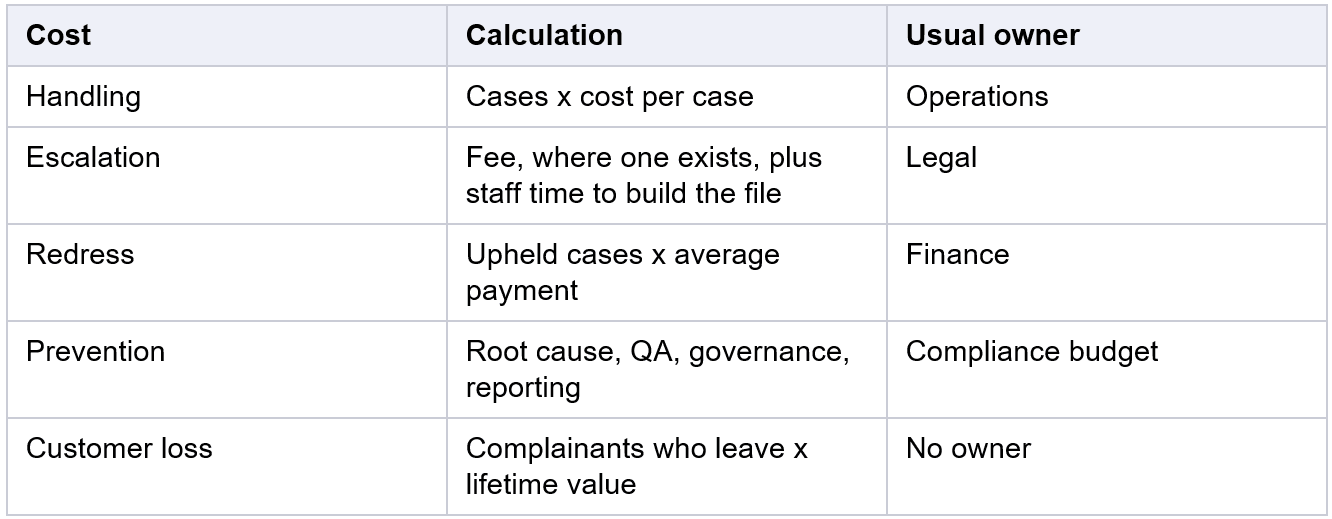
How do you reduce complaints, and still keep the customer when one happens?
Three moves, in order of what they cost you. Prevent where you can. Payment patterns, repeat contact attempts, vulnerability flags, and affordability signals point to customers likely to complain before they do. A proactive conversation costs less than any stage that follows. Germany is a useful reminder of where volume comes from: BaFin's consumer protection lead attributes much of the 2025 rise to reachability and service quality, which is to say, how easily a customer can get hold of someone and what happens when they do. Resolve early where you can. Every market rewards this, though differently. A summary resolution in the UK. A cheaper fee stage in Australia. A met deadline in Canada. A shorter public record in the US. A better ranking position in Germany and Brazil. Recover well when it matters. A complaint is the moment a customer decides whether to stay. A handler who can see the full history, including any vulnerability, and resolve every part of the complaint in one response turns a bad experience into a reason to stay. The same data then informs underwriting, affordability, product design, and pricing, so the issue does not come back.Where should a firm start?
Establish the current cost first. Automating a process, or bringing agentic AI into one, is an economic decision before it is a technical one. The sequence matters too: outcomes first, then people and process, then technology. In reverse, you tend to automate the same problem faster. There are four paths. Which comes first depends on where your constraint sits, what you can invest, and what else competes for the same people. Fix the case record One front door, so a complaint received by phone, email, chat, or social media enters the same queue on the same clock. Classification at capture rather than at triage, so the right deadline is set on day one, including the short payment services clock. Multi-part complaints linked as one record with consolidated redress. Skills-based routing to a handler with the relevant product knowledge. What delivers it: Service Cloud for omnichannel intake, routing, knowledge, and SLA timers, together with the complaint management data model in Financial Services. Take retrieval out of the handler's day Fetching, chasing, and file assembly move out of the handler's work, and the decision stays with them. Evidence is gathered as the case runs rather than requested from another team, and people step in where judgment is needed and at exceptions. What delivers it: Agentforce Operations to orchestrate the work around the case and record every agent and human action with a timestamp, Agentforce inside the case for summaries, next best action, and response drafts, and MuleSoft for governed access to the systems where evidence lives. Cut escalation cost Fewer cases escalate, and those that do produce a file by export rather than reconstruction, because the audit trail was built during the case. Stronger final responses also reduce how many customers escalate in the first place. What delivers it: a complete, timestamped case record, with case history, linked aspects, and redress held in one place. Send the complaint signal upstream Consistent categories make root cause analysis reproducible. Confirmed findings reach product, pricing, and underwriting. The complainant list reaches the retention team. The regulatory return comes out of the same data the operation runs on. Three regulators have now said versions of the same thing: what reaches the board is volume, not cause. The FCA found board reports with operational data but no root causes or preventive actions. The ACPR found annual summaries analyzing volume alone. Brazil scores whether the answer satisfied the customer at all. For a group, this path is also what makes four country-level category sets comparable, so a defect appearing in four markets reads as one issue rather than four. What delivers it: Data 360 to unify complaint records with product, transaction, and servicing data, Tableau for thematic reporting, board reporting, and regulatory returns, and Marketing Cloud to deliver the complaint-derived retention list to the team accountable for churn. This path usually takes longest, because it crosses functions and depends on the categorization discipline the first path establishes. Firms that already tag consistently can start here.Questions worth asking internally
- Across your last hundred complaints, how many days passed between receipt and the case reaching the person who decided it?
- Which of your markets has the shortest deadline, and do you measure against it or against your most generous one?
- When a case escalates, is the file exported from one system or rebuilt from several?
- Of the complaints you upheld last quarter, how many changed a product, a process, or a price?
- If you operate in more than one market, can you add your complaint categories together?
- What does your board see each quarter: how many complaints, or what caused them?



Frequently asked questions
Five costs: handling (cases multiplied by cost per case), escalation (the external body's fee, where one exists, plus the staff time to assemble the file), redress (upheld cases multiplied by the average payment), prevention (root cause analysis, quality assurance, governance, and reporting), and customer loss (complainants who leave multiplied by lifetime value). Four have an owner in most firms. Customer loss usually has none.
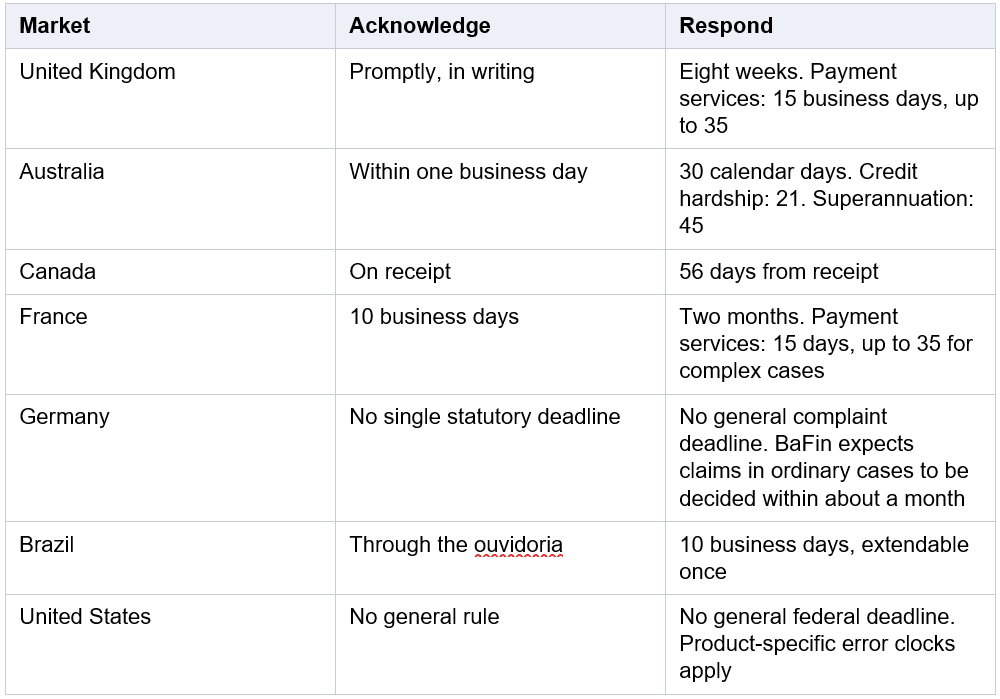
It depends on the market. Eight weeks in the UK, 30 calendar days in Australia, 56 days in Canada, two months in France, and 10 business days through the ouvidoria in Brazil. Payment services complaints run on much shorter clocks in the UK and France: 15 business days, extendable to 35. Germany and the United States have no single general deadline.
That depends on how the external scheme is funded. A flat fee per case in the UK, up to £680 for 2026/27. A staged fee in Australia, rising from nothing before referral to $1,141 at case management. No fee but a hard deadline in Canada. No fee but a public record in the United States. No fee but a published ranking in Germany and Brazil. In every market, the staff time to assemble the file is the part nobody budgets for.
By treating complaints as findings rather than cases to close. Most complaints a firm decides are upheld, which makes each one a confirmed finding about a product, price, process, or communication. Reducing future volume means categorizing consistently at intake, making root cause analysis reproducible, and getting those findings to the teams who can fix the cause.
Full set for the global piece, same shape as the UK one.
 Agentforce Operations
 Financial Services
 Trailblazing Growth: AAG and OSF Digital Partner to Transform Financial Services and Fleet Operations Through AI-Powered Innovation on Salesforce