
Lessons, Best Practices, and Returns from OSF Digital's Manufacturing Transformation Programs
Schedule a meeting- In OSF Digital's manufacturing programs, the largest gains were measured in customer self-service. One manufacturer grew online orders fourfold in 12 months and cut inbound calls by 70%.
- One ERP integration of pricing, inventory, and order data supported commerce, sales, and marketing at a hardware manufacturer and cut marketing effort by 35%.
- In dealer networks, order errors begin at intake, so automating order entry precedes redesigning ERP processes.
- Manufacturers adding subscriptions and services tend to hit limits in quoting and approvals first, which makes quote-to-cash a strong first phase.
- AI pays off first in narrow, rule-bound work such as discount approvals and order intake, once the underlying data is connected.
What did OSF Digital's manufacturing programs solve, and what did they deliver?
OSF Digital's manufacturing programs solved disconnected sales, order, pricing, and customer processes, and delivered measurable gains in online orders, call volume, marketing effort, and admin capacity.Industrial tools and equipment
The challenge: Service reps spent 50% of their time on manual data entry after acquisitionsWhat OSF Digital did: Connected B2B Commerce, Sales Cloud, Service Cloud, Data 360 and Snowflake; added AI self-serviceThe result: 4x online orders in 12 months; 70% fewer inbound calls; hundreds of hours saved monthlyRead →Hardware and building materials
The challenge: Legacy regional storefronts; no unified CRM; basic marketing automationWhat OSF Digital did: Connected ERP, pricing, inventory and order data with MuleSoft; one B2B Commerce storefront; Marketing Cloud NextThe result: 35% less marketing effort; 15% higher customer engagementRead →Advanced machinery and equipment
The challenge: Spreadsheet-driven sales and service across several countriesWhat OSF Digital did: Sales Cloud, Service Cloud and Field Service as one source of truthThe result: 70% growth in admin capacity; full customer view; more upsell and cross-sellRead →Flavors, fragrances and ingredients
The challenge: Global sales teams split across disconnected PLM and ERPWhat OSF Digital did: Global core model on Manufacturing Cloud and Sales Cloud; PLM integration; regional MVPThe result: 900+ sales professionals on one standardized processRead →Healthcare linen and uniform solutions
The challenge: Quoting, approvals and renewals across legacy systems; slow approvals hurting marginWhat OSF Digital did: One quote-to-cash workflow in Revenue Cloud Advanced and AgentforceThe result: Guided pricing and discount approvals from quote to renewalRead →Lawn, garden and agricultural consumer products
The challenge: Trade spend on spreadsheets; no enterprise view of promotion returnsWhat OSF Digital did: Consumer Goods Trade Promotion Management and Effectiveness, phasedThe result: Real-time budget tracking; rollout across major retail and distribution channelsRead →Semiconductors and electronic components
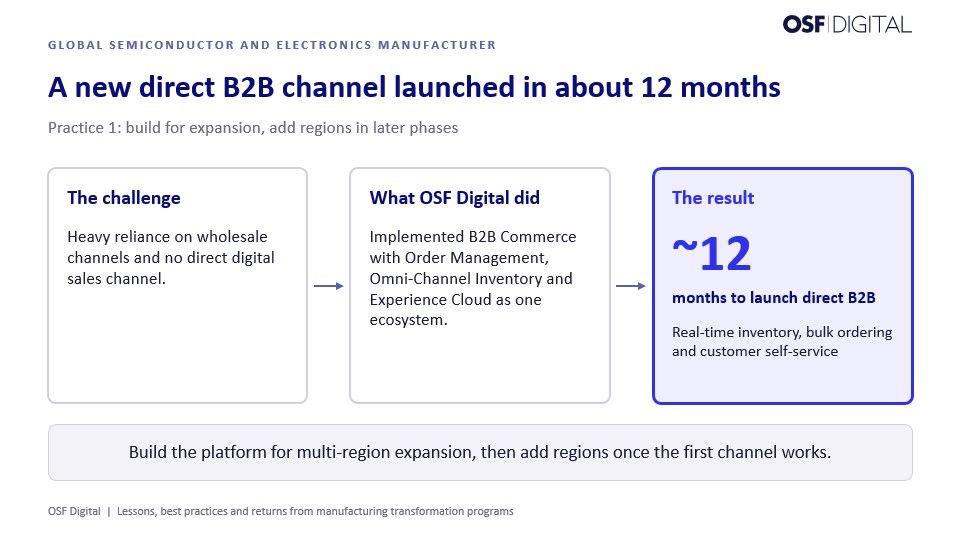
The challenge: Heavy reliance on wholesale; no direct digital channelWhat OSF Digital did: B2B Commerce with Order Management, Omni-Channel Inventory and Experience CloudThe result: New direct B2B channel launched in about 12 monthsRead →Technology hardware and software
The challenge: 160,000+ dealer orders a year (over 80%) keyed into SAP by handWhat OSF Digital did: Designed: intelligent document processing for PDF orders, real-time Salesforce-SAP integration, Agentforce Revenue ManagementThe result: Less manual order entry, fewer order discrepancies, faster discount approvals and complete partner data for incentives and warrantiesRead →Products and logistics provider
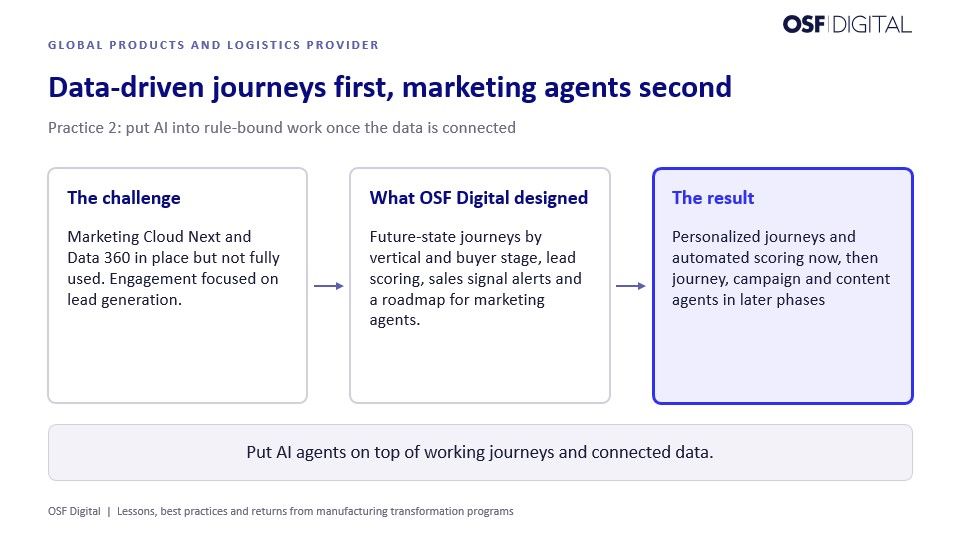
The challenge: Marketing Cloud Next and Data 360 in place but not fully usedWhat OSF Digital did: Designed future-state journeys, lead scoring and an agent roadmapThe result: Journeys personalized by vertical and buyer stage, automated lead scoring and campaigns, and sales signal alerts for consultantsRead →Where did the biggest returns come from?
The biggest returns in OSF Digital's manufacturing programs came from customer self-service, integrations that served multiple functions, and moving sales and service off spreadsheets.Self-service: 4x online orders and 70% fewer inbound calls
The challenge: an industrial tools manufacturer growing through acquisitions had no single view of its customers. Service reps spent half their time on manual data entry.What OSF Digital did: connected B2B Commerce, Sales Cloud, Service Cloud, Data 360, and Snowflake into one customer view, then added AI-powered self-service.The result: online orders grew fourfold within 12 months, inbound calls fell 70%, and the team saved hundreds of hours a month.Why it paid back: once customers could see their own orders, inventory, and account data, they completed transactions without calling. The return came from work the customer took over. Read the story →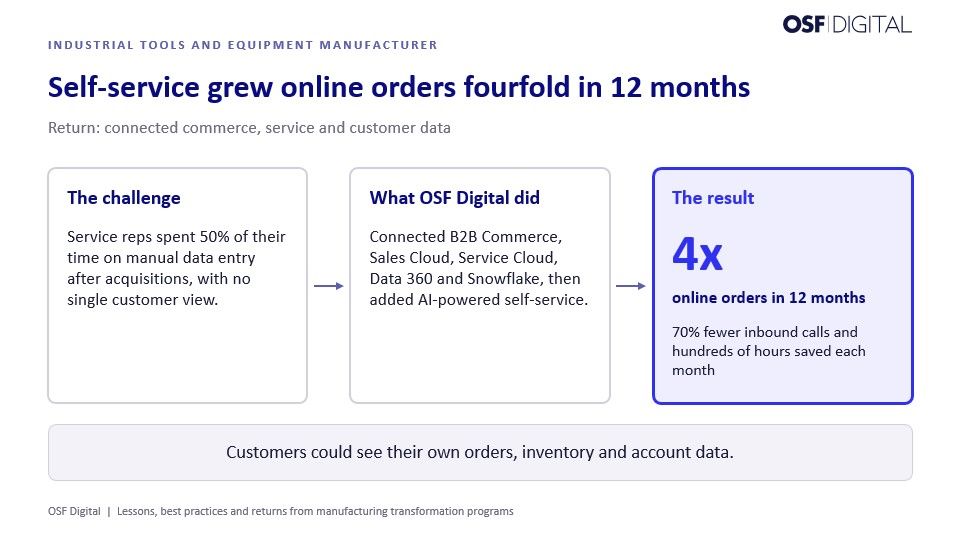
One integration, three functions: 35% less marketing effort
The challenge: a hardware and building-materials manufacturer operated separate regional storefronts. Sales lacked a unified CRM or visibility into KPIs, and marketing relied on basic automation.What OSF Digital did: used MuleSoft to connect ERP, product, pricing, inventory, order, and customer systems. That one integration layer then supported a single B2B Commerce storefront, Sales Cloud with Salesforce Maps and Einstein, and Marketing Cloud Next journeys and agents.The result: marketing effort fell 35%, and customer engagement rose 15%.Why it paid back: commerce, sales, and marketing all drew on the same connected data, so a single integration investment delivered value across three functions. Read the story →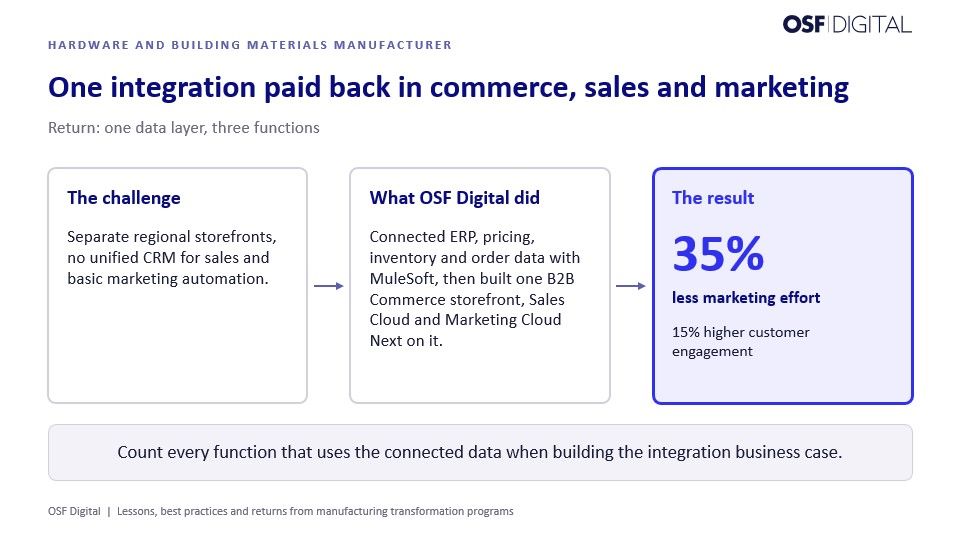
Off spreadsheets: 70% growth in admin capacity
The challenge: an advanced machinery manufacturer ran sales and service on spreadsheets across several countries, with no shared customer view.What OSF Digital did: implemented Sales Cloud, Service Cloud, and Field Service as one source of truth, including data preparation and migration, and standardized processes across regions.The result: 70% growth in admin capacity, a full view of each customer, and more upsell and cross-sell opportunities.Why it paid back: sales, service, and field teams stopped re-entering the same customer data, and a shared customer view made cross-sell opportunities easier to spot. Read the story →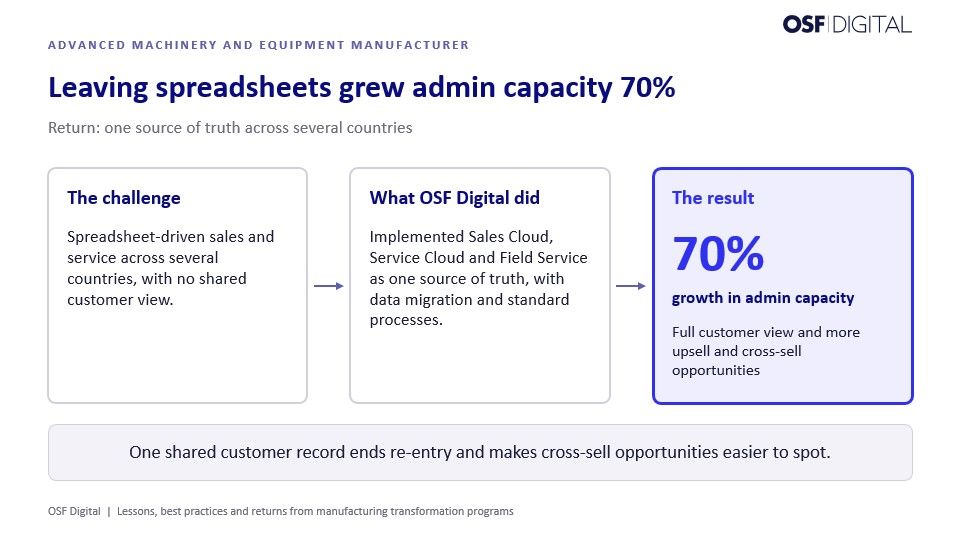
What lessons do OSF Digital's manufacturing programs offer?
Three lessons from OSF Digital's manufacturing programs change where a first phase should start: fix order intake in dealer networks, fix quoting when the business model changes, and treat the first region as a template.Lesson 1: In dealer networks, order errors start at intake
The challenge: a global technology manufacturer was keying more than 160,000 dealer orders a year into SAP by hand, over 80% of its volume. Thousands of dealers used no common purchase order format. Discount approvals stalled because Salesforce and SAP were not connected, and incomplete partner data led to incentive and warranty issues.What OSF Digital designed: a fix that starts where orders enter. MuleSoft intelligent document processing reads PDF purchase orders, MuleSoft connects Salesforce and SAP in real time, and Agentforce Revenue Management standardizes quoting.The lesson: in a dealer-heavy business, automate the entry of orders before redesigning how the ERP processes them. Clean intake cuts the correction work that follows. Read the story →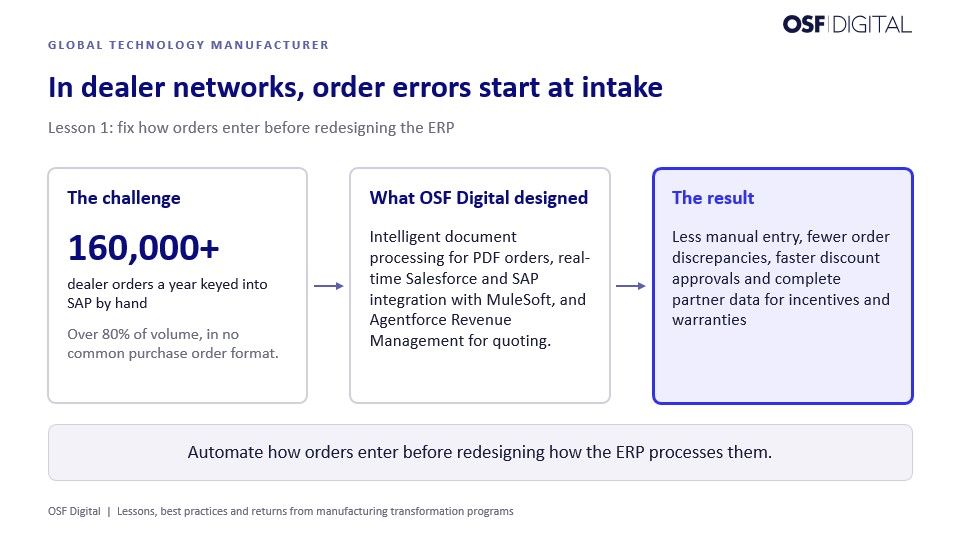
Lesson 2: New business models break quoting before they break the ERP
The challenge: a healthcare linen and uniform manufacturer runs equipment subscriptions, purchases, and services side by side. Quoting, approvals, discounting, and renewals sat across legacy systems, heavy custom configuration, and offline workflows. Slow approvals hurt sales velocity and margin.What OSF Digital did: consolidated quote-to-cash into one Revenue Cloud Advanced and Agentforce environment, built mainly on out-of-the-box capabilities, with targeted training and guided user journeys.The result: one continuous workflow from quote creation through discounting to renewal, with built-in guided pricing and discount decisions.The lesson: a manufacturer adding subscriptions or services should expect quote-to-cash to become the constraint before the ERP does. Read the story →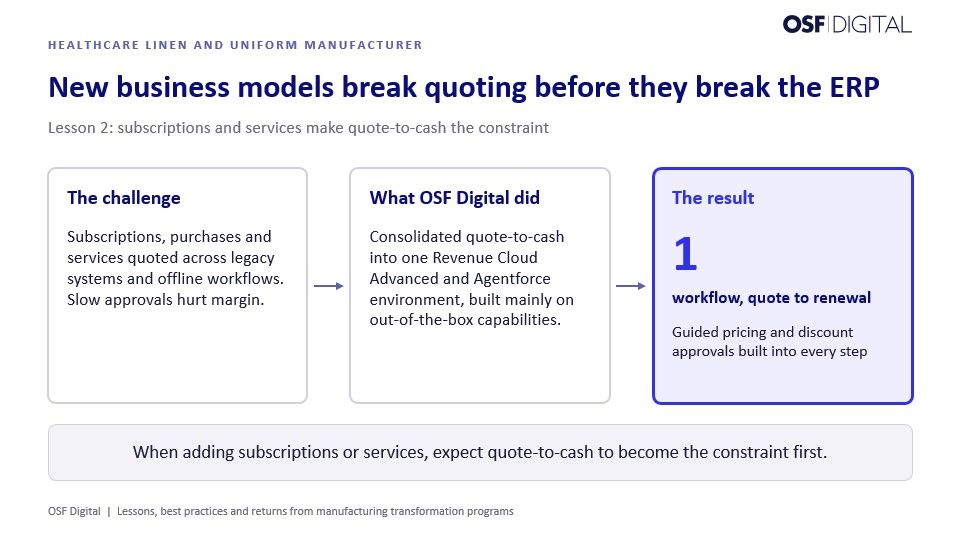
Lesson 3: The first region's real output is the template
The challenge: a global flavors, fragrances, and ingredients manufacturer had international sales teams split across disconnected PLM and ERP systems, with no dedicated sales tool.What OSF Digital did: built a global core model on Manufacturing Cloud and Sales Cloud, modernized and integrated the PLM, and launched the model as a regional MVP with dedicated change management.The result: more than 900 sales professionals on one standardized process across regions.The lesson: judge the first region by how much the next region can reuse. Decide which regional differences are real before the first rollout, so later regions do not reopen the design. Read the story →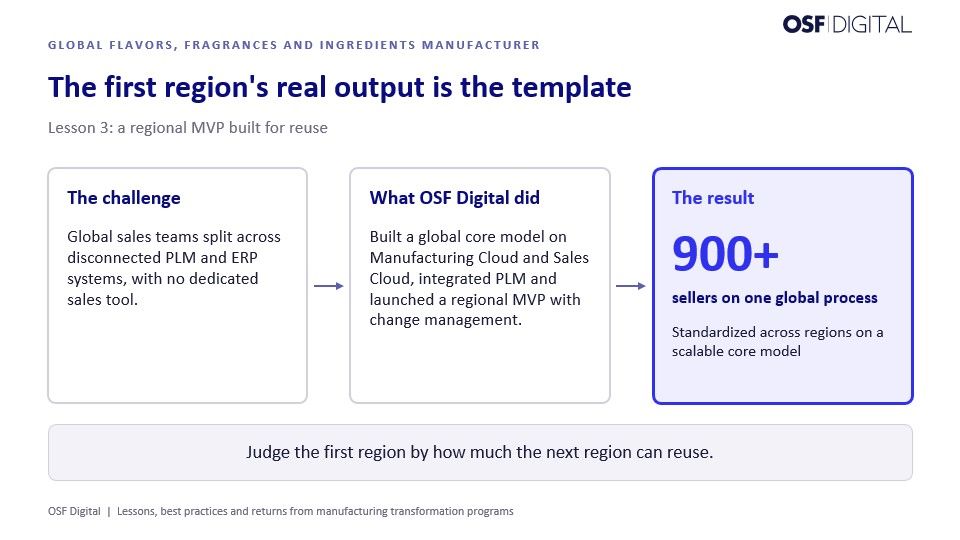
Which best practices does OSF Digital apply in manufacturing transformation?
OSF Digital applies three best practices for manufacturing transformation: phase the rollout by where value appears first, apply AI to rule-bound work once the data is connected, and include adoption in the original scope.Practice 1: Phase the rollout by where value appears first
The challenge: a lawn, garden, and agricultural consumer products manufacturer ran trade promotion planning and spend on spreadsheets. Teams worked separately, and there was no enterprise view of what promotions returned.What OSF Digital did: implemented Consumer Goods Trade Promotion Management and Trade Promotion Effectiveness in phases. Priority business groups went live first, with real-time budget tracking, financial controls, and claims management.The result: priority groups saw value early, and the rollout then extended across multiple major retail and distribution channels. Read the story →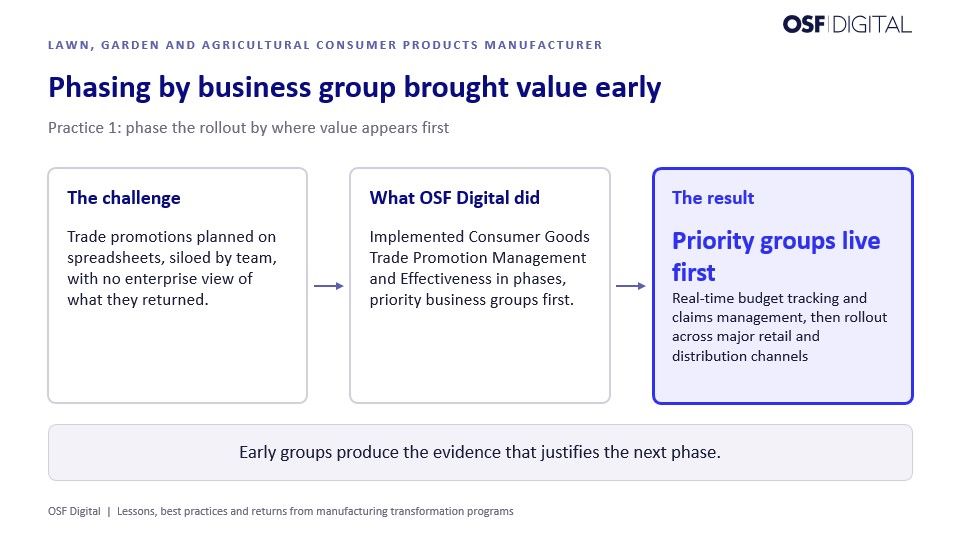
Practice 2: Put AI into rule-bound work once the data is connected
Across these programs, OSF Digital applied AI first where the decision rules were clear, and the data was already connected:- Approval queues: Agentforce guides pricing and discount approvals in the quote-to-cash program, and a person approves exceptions.
- Order intake: the technology manufacturer's design starts AI on reading PDF purchase orders before they reach SAP.
- Self-service: the industrial tools manufacturer added AI-powered self-service after its customer data was unified.
Practice 3: Include adoption in the original scope
Every program delivered in this set included change management, training, or managed services from OSF Digital in its original scope. The consumer products rollout combined change management, user training, enhancement services, and production support. The flavors and fragrances program funded dedicated change management from the regional MVP onward. The hardware manufacturer's program included onboarding, journey migration, and ongoing managed services.How can a manufacturer apply these lessons to its own operations?
A manufacturer can apply these lessons through an OSF Digital manufacturing working session, which turns the findings above into a first phase the executive team can approve.The session fits manufacturers that are:- moving from wholesale to direct B2B sales;
- adding subscriptions or services to equipment sales;
- integrating customers and data from acquired companies;
- processing high order volumes from dealers and distributors; or
- consolidating regional storefronts, brands, or sales processes.
- The first transaction to fix, and the evidence for choosing it.
- The returns that transaction can produce in self-service, intake, and the functions that share its data.
- One accountable owner and a first-phase scope, including what is deferred and why.
- The global core and approved local variations, if a regional rollout is planned.
- The baselines that will prove the first phase, and where AI fits once the rules are clear.



Frequently asked questions
Manufacturers rarely need to replace ERP or PLM to connect sales and operations. In most of OSF Digital's manufacturing programs, ERP and PLM stayed the systems of record, and OSF Digital integrated them with sales, commerce, and service. Replacement makes sense when a system can no longer reliably own its transactions.
In OSF Digital's programs, the first process varied by business model. For a dealer-heavy manufacturer, OSF Digital's design started with order intake. For a manufacturer adding subscriptions and services, the program started with quote-to-cash. Where customers called often about orders and inventory, B2B self-service produced the largest measured gains.
A manufacturing process is ready for AI agents when its owners can name the decision, the data it needs, who approves exceptions, and how the result is checked. Approval queues and order intake usually meet that test first. Broader autonomy follows once the controls have worked in production.
The first phase should be measured against a baseline set before work begins. Useful measures include manual order volume, quote approval time, inbound call volume, online order share, and admin time. Each measure needs a named owner.
A manufacturer needs the leaders who own sales, operations, IT, and data in the room, plus a short list of the transactions causing the most friction. Baseline figures help. If they are missing, the session identifies which ones to set.
After the session, the executive team has a first-phase scope it can approve, defer, or compare with other options. If it chooses to proceed, OSF Digital turns that scope into an implementation plan.
 The Commerce Shift: How Manufacturers and Auto Brands Are Reducing Cost-to-Serve
 From Pilots to Pattern: The Operating Model for the Agentic Enterprise
 This Is Not Another Technology Cycle: An Executive Point of View on the Agentic Enterprise