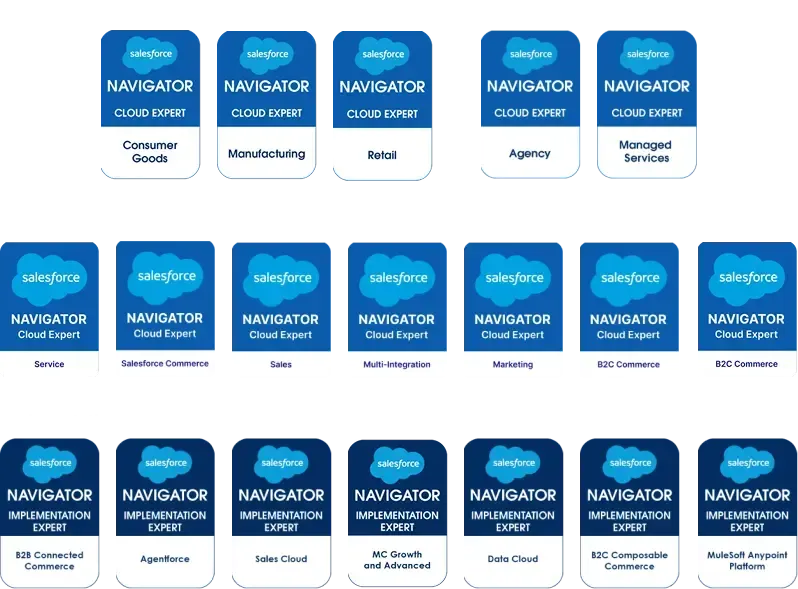
OSF Digital has recently reached 19 Salesforce Expert recognitions across Products, Services, and Industries. On the surface, that reflects the breadth of our expertise. At a deeper level, it reflects something more important: delivery depth across the architecture required to deploy enterprise-grade capabilities at scale.Those recognitions span commerce, sales, service, marketing, Data Cloud, MuleSoft integration, Agentforce, managed services, and industry specializations in Retail, Consumer Goods, and Manufacturing. That range mirrors the way modern enterprises actually operate - not in silos, but across connected systems and workflows.Salesforce Navigator Cloud Expert badges grouped by industries, services, products, and implementation categories.
Why Depth Across Products, Services, and Industries Matters
Building an Agentic Enterprise requires more than enabling AI features. It requires operational readiness - the ability to integrate, govern, orchestrate, and scale without introducing instability.Enterprise initiatives struggle when systems do not align, when data cannot move smoothly across the organization, when integration layers are fragile, and when governance is unclear. From a delivery perspective, depth across Products, Service Domains, and Industries is not just a decorative milestone - it is an architectural necessity.Enterprise-grade automation and intelligent workflows do not operate within a single cloud. They interact across customer journeys, supply chains, revenue processes, service operations, and marketing ecosystems. Successful deployment requires understanding how data flows across the organization, where governance boundaries apply, and how industry-specific workflows behave in production environments.If one layer is weak, performance degrades. If integration is fragmented, processes stall. If governance is missing, risk increases.
From Cloud Implementation to Enterprise Orchestration
Today transformation looks different than it did even a few years ago. It is no longer about successfully implementing a single cloud. It is about orchestrating multiple clouds into a cohesive operating model. Teams are not simply asking how to implement another system. They are asking how everything fits together, how commerce connects to service, how marketing uses the same data as sales, and how decisions made in one area do not create friction in another.Transformation has shifted from isolated projects to orchestration. Multiple clouds must work as one. Data must move seamlessly across them. Workflows must reflect how the business actually operates, not how an individual system is designed.When intelligent capabilities are layered on top of disconnected foundations, complexity multiplies. Automation only delivers value when it operates inside structured environments. When data is fragmented, automation hesitates. When integration is weak, processes stall. When governance is unclear, innovation becomes unpredictable.That’s when operational readiness becomes the real differentiator. It is not about how quickly a new capability can be switched on. It is about whether the organization is prepared for that capability to act inside real workflows, across real systems, affecting real outcomes.That is what depth ultimately enables - the ability to design systems that work together rather than compete with one another.
What This Means for Our Customers
Enterprise transformation involves multiple interconnected decisions spanning systems, teams, data, and processes to create efficient value streams.A knowledgeable partner helps minimize risk and enhance coordination across commerce, service, sales, marketing, finance, operations and data environments.This shift demands a new approach to enterprise architecture—one that prioritizes interoperability, resilience, and adaptability at every layer. Leaders must consider not just the technology choices, but also the change management, talent development, and operational governance required to support ongoing transformation. It is essential to foster collaboration across business units and IT, ensuring that each new initiative strengthens the overall ecosystem rather than creating silos or redundancies.OSF Digital’s depth across the Salesforce ecosystem coupled with our domain and indisutry expertise enables organizations to move forward with clarity and confidence. Cross-cloud delivery experience and industry insight help create environments that are stable, integrated, and ready to evolve as the business grows.If you are navigating multi-cloud complexity or preparing your organization for scalable, AI-enabled operations, connect with OSF Digital to assess your current readiness and define a practical path forward.
Author: Sandra Swindle
Sandra Swindle is Executive Vice President of Global Delivery at OSF Digital. With 20+ years of experience in enterprise operations, global delivery frameworks, and data-driven transformation, Sandra focuses on advancing delivery excellence across complex Salesforce initiatives. She leads OSF’s global delivery organization, helping expand AI-enabled Salesforce implementations while strengthening operational efficiency across the company.