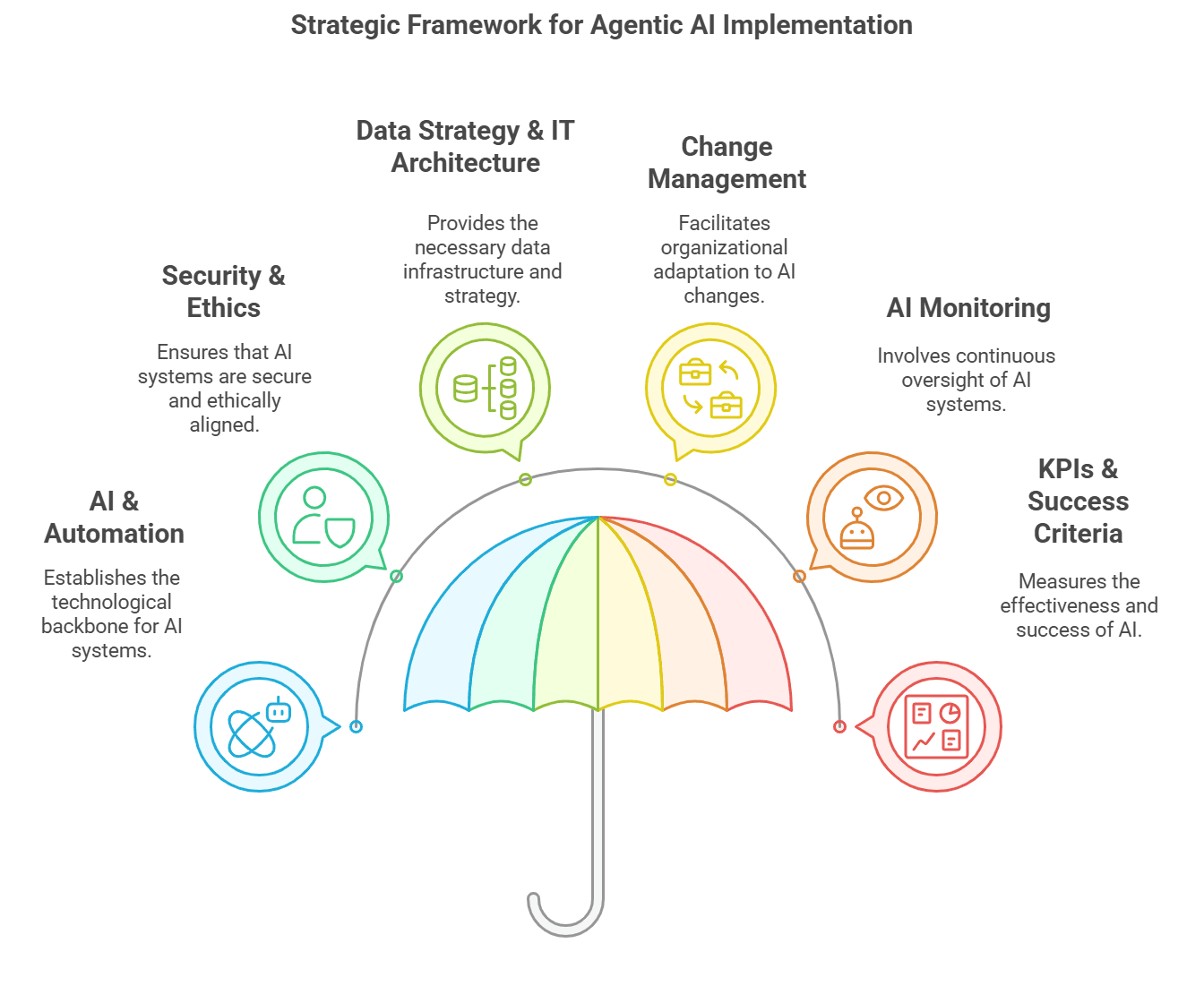
In the rapidly evolving landscape of technology, Agentic AI signifies a transformative shift in the structuring and management of information systems. Unlike traditional end-user applications and SaaS/Cloud solutions, Agentic transformations demand the integration of new capabilities to effectively manage autonomous agents. This involves handling large volumes of unstructured data and ensuring seamless system integrations with governed and protected APIs.In the long term, Agentic AI will require the operation of dozens or even hundreds of agents within an information system. Therefore, it is crucial to start building the right foundations now to enable quick scaling at reasonable costs while maintaining trust.Diagram of strategic framework for agentic AI implementation, showing six key areas under an umbrella.
Strategic Consulting and Change Management
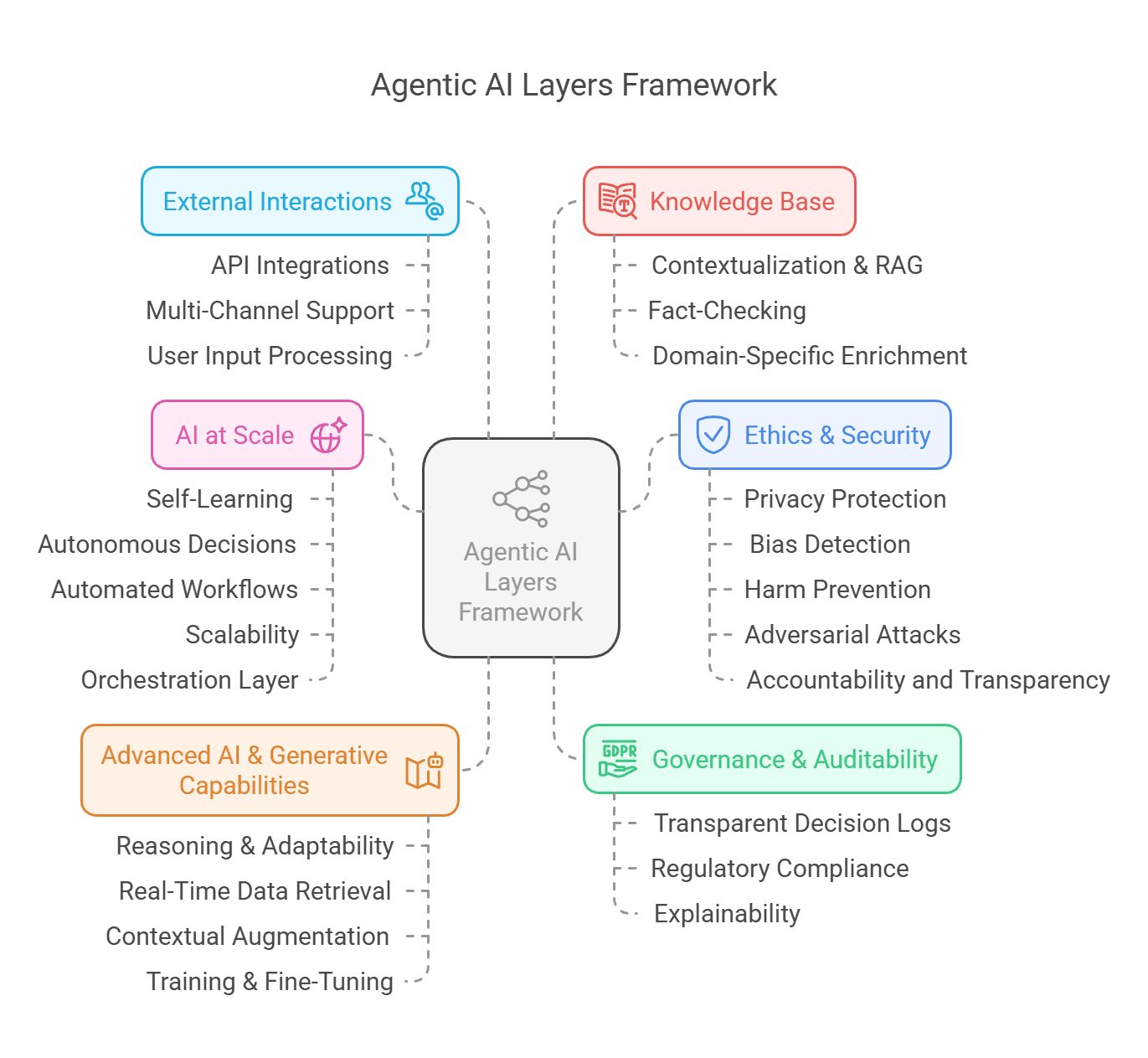
Implementing Agentic AI necessitates robust strategic consulting to establish frameworks in AI & Automation, Security & Ethics, and Data Strategy & IT Architecture. Additionally, strong change management is essential to transform aspects related to People & Organization, Tools & Processes. Once Agentic AI is integrated into your information system, continuous AI Monitoring, along with KPIs & Success Criteria, will be vital to measure and ensure its effectiveness.Diagram showing the Agentic AI Layers Framework with six key interconnected components.
The Agentic AI Layers Framework
The framework is built on several key components:1. Governance & Auditability for Transparency & Compliance
Transparent Decision Logs: AI maintains a history of its decisions for accountability and audits.
Regulatory Compliance: AI adheres to legal and ethical standards for responsible deployment.
Explainability: Provides clear reasoning behind AI decisions to foster trust and reliability.
2. AI at Scale for Operational Independence
Self-Learning: Continuously improves performance based on feedback.
Autonomous Decisions: AI acts independently within defined rules.
Automated Workflows: Streamlines repetitive tasks for efficiency.
Scalability & Real-Time Decision Making: Optimizes resources and makes instant decisions based on data.
Orchestration Layer: Manages multi-agent routing, coordination, and supervision.
API Integrations: AI connects with external systems to fetch and process data.
Multi-Channel Support: Interacts via text, voice, and images for a richer user experience.
User Input Processing: Utilizes NLP to understand and respond to human queries.
4. Ethics & Security
Privacy Protection: Ensuring robust cybersecurity to prevent data breaches and managing consent for data use across different jurisdictions.
Bias Detection: Continuously monitoring and correcting algorithmic biases to ensure fairness across different demographic groups.
Harm Prevention: Implementing mechanisms to verify AI outputs and ensuring ethical use to prevent misinformation and misuse.
Adversarial Attacks: Developing defenses against inputs that manipulate AI systems to produce incorrect outputs.
Accountability and Transparency: Establishing clear accountability for AI decisions and providing transparent explanations to build trust.
5. Knowledge Base
Contextualization & RAG (Retrieval-Augmented Generation): Fetches relevant information for better context-aware responses.
Fact-Checking: Ensures AI outputs are based on verified information.
Domain-Specific Enrichment: Enhances AI capabilities in specialized fields like healthcare, finance, and law.
6. Advanced AI & Generative Capabilities
Reasoning & Adaptability: Processes complex queries and adapts to user intent.
Real-Time Data Retrieval: Pulls external data to generate accurate responses.
Contextual Augmentation: Expands AI’s knowledge by integrating external sources.
Training & Fine-Tuning: Continuously improves through training updates andReinforcement Learning (RL).
The Importance of Agentic AI
As AI systems become more autonomous and decision-driven, ensuring transparency, compliance, and ethical AI governance is crucial. This is especially important in industries like finance, healthcare, cybersecurity, and enterprise automation, where the stakes are high, and the need for reliable and responsible AI is paramount.At OSF, we provide AI expertise that combines business and industry process knowledge. We also offer an "Agent Factory" to deploy and manage a large number of agents, addressing all data strategy challenges, including architecture, integration & migration, configuration, and optimization.Ready to explore how Agentic AI can transform your business? Contact us today to discuss your AI strategy and take the next step toward scalable, autonomous information systems.Whether you’re exploring AI adoption, multi-cloud transformation, or customer experience innovation, OSF Digital is ready to guide your next step. Get in touch with us to get started.
Author: Anthony Grost
Anthony Grost, Regional Vice President for Client Services EMEA at OSF Digital, leverages his extensive expertise in business strategy to lead senior management through digital transformation and optimize performance across global markets.